
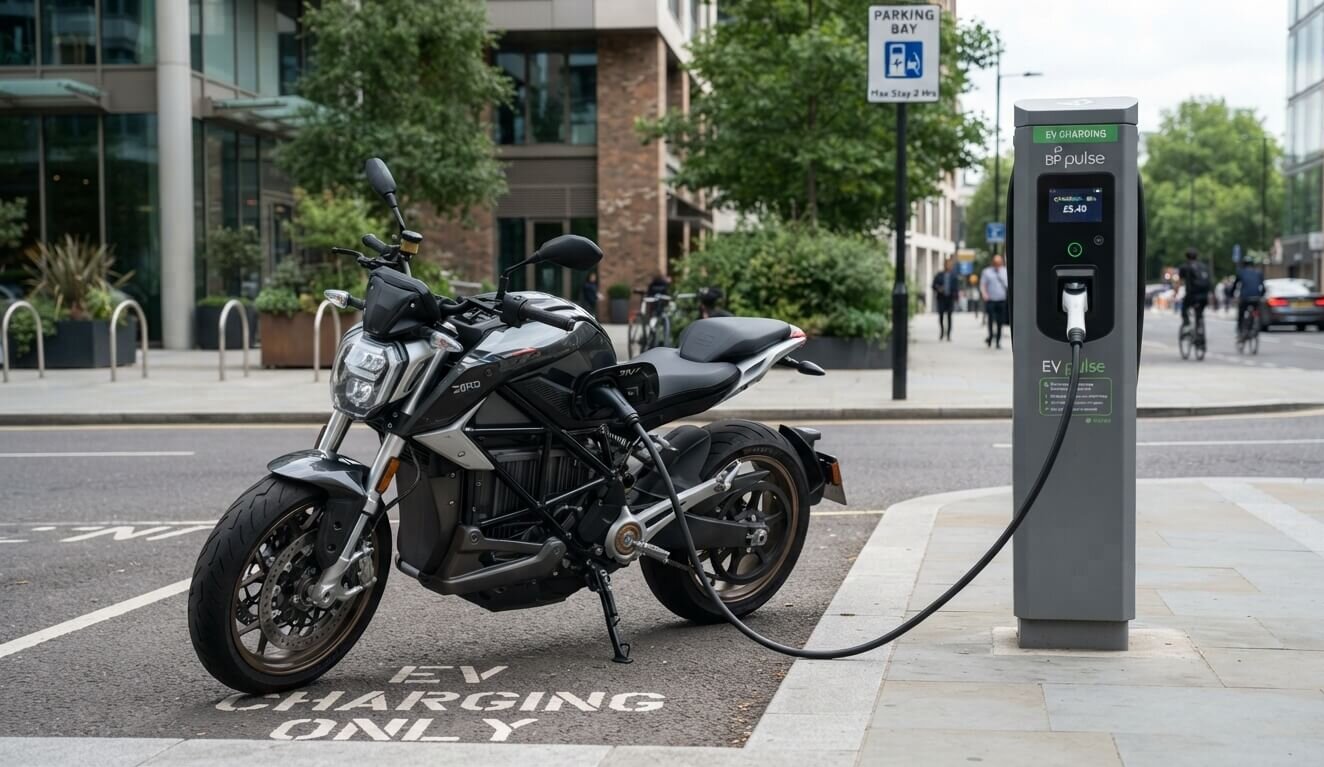
Electric motorcycles have moved from novelty to a genuine alternative for some riders. They are quick, quiet, mechanically simpler than gasoline motorcycles in several important ways, and increasingly available from established manufacturers.
But buying one still raises questions that rarely come up with a conventional motorcycle.
How far will it actually go? How long does charging take? What happens when the battery gets old? Are electric motorcycles cheaper to maintain? Can you tour on one? And what exactly needs servicing when there is no engine oil, fuel system or exhaust?
The short answer is this:
Electric motorcycles can work very well for commuting, urban riding and shorter recreational trips when charging is easy to access. They require less conventional engine maintenance, but range, charging speed, battery condition and electronic systems become much more important parts of ownership.
Here is what you need to know before deciding whether one makes sense for you.
Electric motorcycles at a glance
| Question | Typical electric motorcycle |
|---|---|
| Power source | Rechargeable lithium-ion battery |
| Motor | Electric |
| Engine oil changes | Normally no |
| Spark plugs | No |
| Fuel | No |
| Exhaust | No |
| Conventional clutch | Usually no |
| Manual gearbox | Usually no |
| Regenerative braking | Common |
| Home charging | Available on many models |
| Public charging | Depends on model and connector |
| Tires, brakes and suspension | Still require maintenance |
| Battery and electronic diagnostics | Increasingly important |
| High-voltage precautions | Required for some repair work |
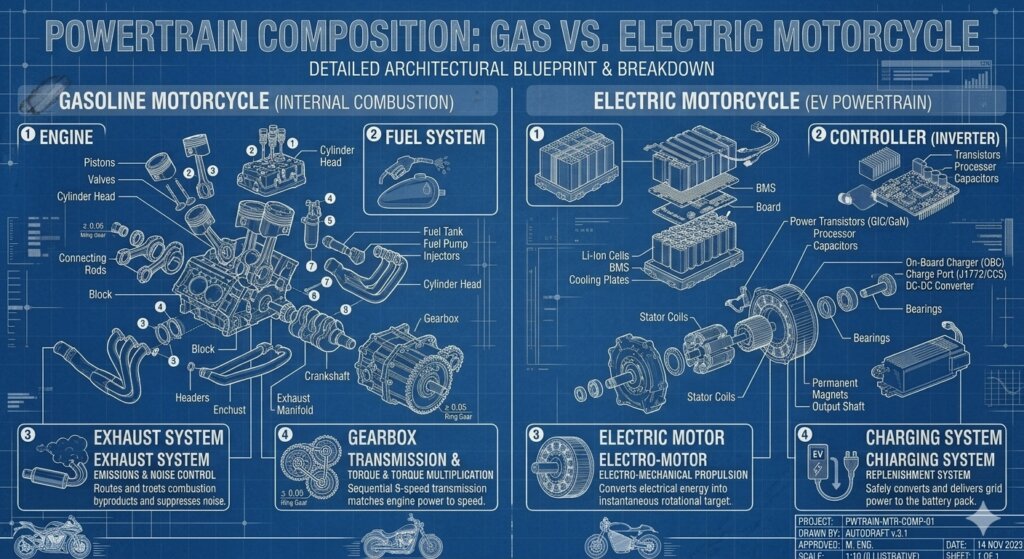
Electric motorcycles usually require less routine engine maintenance because there are no oil changes, spark plugs, fuel systems or valve adjustments. Their biggest practical differences are battery range, charging speed and charging access. City range is generally much higher than sustained highway range, while battery health becomes particularly important when buying used. Brakes, tires, suspension and final-drive systems still require normal motorcycle maintenance.
The biggest ownership difference is not simply that electricity replaces gasoline.
The things you maintain, monitor and plan around are different.
How does an electric motorcycle work?
A gasoline motorcycle creates power by burning fuel inside an internal-combustion engine.
An electric motorcycle takes a more direct route.
Energy stored in a high-voltage battery is sent through electronic controls to an electric motor. The motor converts that electrical energy into rotation, which drives the rear wheel.
A modern electric motorcycle will typically have:
- a high-voltage traction battery
- an electric motor
- a battery-management system
- an inverter or motor controller
- charging hardware
- electronic control modules
- temperature and position sensors
- a low-voltage electrical system
- a final drive using a belt, chain or another system
- cooling hardware on some models
There are no pistons, combustion chambers, fuel injectors or exhaust gases involved in producing power.
That removes a surprising amount of mechanical complexity.
It does not remove technical complexity altogether. Much of it simply moves from mechanical components to batteries, electronics and software.
Why do electric motorcycles feel so quick?
Electric motors can produce strong torque almost immediately.
A gasoline engine usually develops its strongest torque within a particular engine-speed range. The rider may need to select the correct gear and increase engine speed before getting maximum acceleration.
An electric motor does not work the same way.
Open the throttle and substantial torque can be available almost immediately.
Current motorcycles show how significant this can be. Zero lists the SR/F at 140 lb-ft of peak torque and 111 hp. LiveWire rates the LiveWire ONE at 84 lb-ft and 100 hp, with a claimed 0-to-60 mph time of 3 seconds.
That immediate response is one of the most noticeable differences for riders moving from gasoline to electric.
Do electric motorcycles have gears?
Most current electric motorcycles do not use a conventional multi-speed motorcycle transmission.
Because an electric motor can operate across a broad range of speeds, many manufacturers use a single-speed direct drive.
That usually means:
- no clutch lever
- no conventional gear changes
- no clutch plates to wear
- no need to downshift when stopping
- no conventional engine stalling
The Zero SR/F, for example, uses a clutchless direct drive and belt final drive. The Can-Am Pulse also uses a clutchless direct drive, although its final drive uses an enclosed chain system.
Not every future electric motorcycle will necessarily follow the same formula, but single-speed drivetrains remain common.
How far can an electric motorcycle really go?
This is usually the first question prospective owners ask, and it is also one of the easiest specifications to misunderstand.
Electric motorcycle range is not one fixed number.
It changes according to:
- speed
- riding style
- rider and passenger weight
- luggage
- hills
- wind
- temperature
- tire pressure
- traffic
- riding mode
- battery condition
- regenerative braking
The difference between city and highway riding can be substantial.
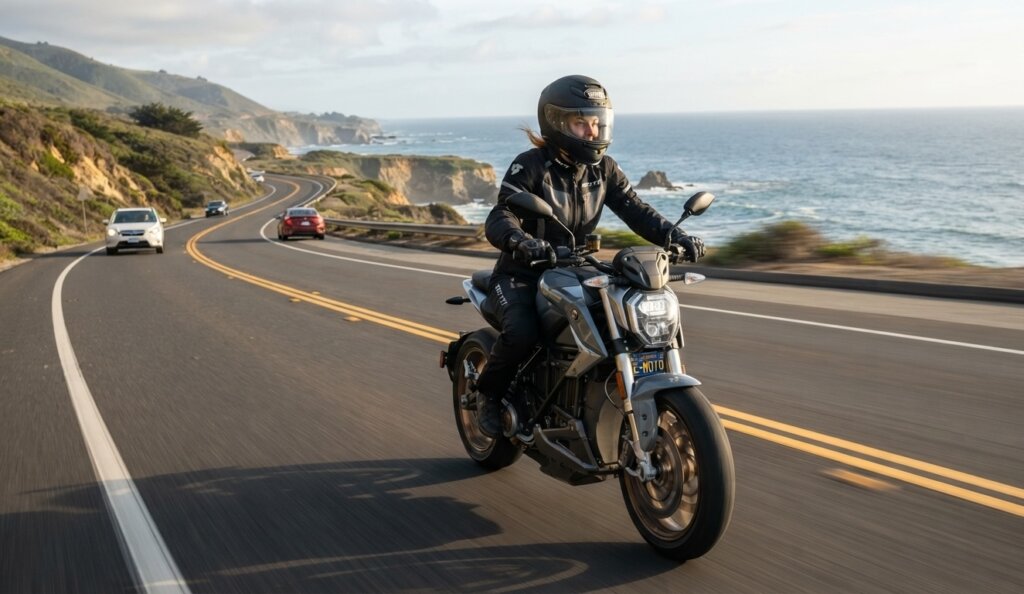
For example, Zero currently lists the SR/F at up to 176 miles of city range and 117 miles of high-speed highway commuting range.
Can-Am rates the 2026 Pulse at up to 100 miles in city use, 80 miles combined, and approximately 55 miles at a sustained 50 mph under its stated test conditions.
LiveWire lists the ONE at 146 miles city and 95 miles combined under its published test methodology.
Why does highway riding reduce electric motorcycle range?
Aerodynamic drag rises rapidly as speed increases.
At lower urban speeds, the motorcycle requires relatively little energy simply to push through the air. Stop-and-go riding can also allow regenerative braking to recover some energy.
At sustained highway speeds, much more energy is required to overcome aerodynamic resistance.
That is why a motorcycle capable of more than 150 miles in city testing may deliver considerably less during continuous highway riding.
Which range number should you use?
Use the figure that most closely matches the way you ride.
If you commute mainly through a city, city range is useful.
If you spend most of your time on highways, ignore the impressive city figure and look for sustained-highway or combined testing.
And leave yourself a margin.
A motorcycle with a theoretical 80-mile range is not necessarily a comfortable choice for a daily 78-mile trip.
How long does an electric motorcycle take to charge?
Anywhere from less than an hour to most of a night.
The answer depends on the motorcycle’s battery, onboard charger and charging system.
Level 1 charging
Level 1 usually means charging from a normal household outlet in markets such as North America.
It is convenient but relatively slow.
LiveWire lists a full Level 1 charge of the LiveWire ONE at around 11 hours. Its S2 platform requires roughly 8.4 hours from empty to full under its stated conditions.
For many commuters, slow overnight charging is not necessarily a problem.
If you ride 30 miles during the day and plug the motorcycle in when you get home, you may rarely need to charge an empty battery from zero.
Level 2 charging
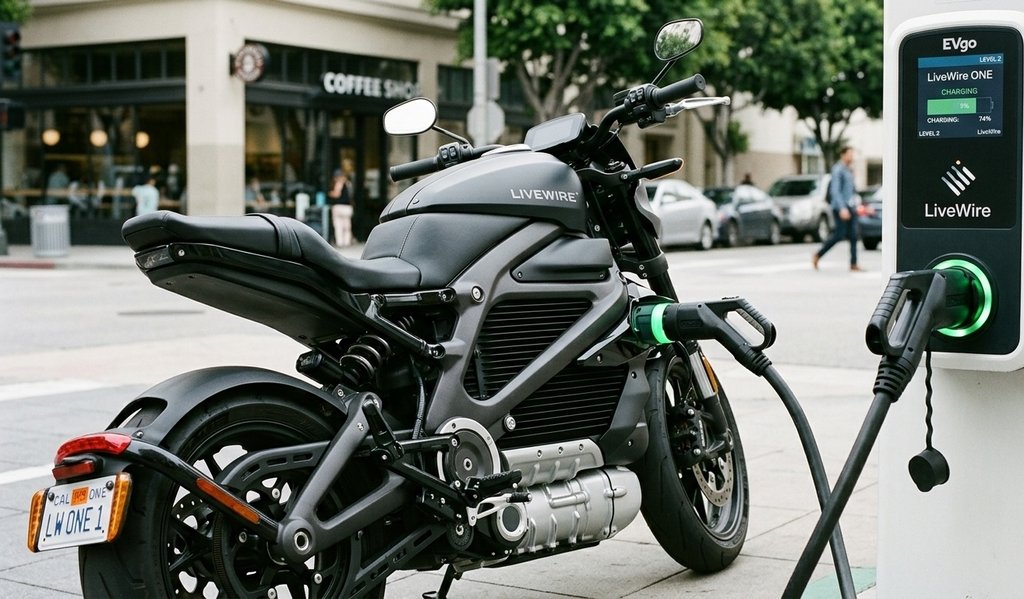
Level 2 charging provides more power, but the motorcycle must be designed to take advantage of it.
The Can-Am Pulse can charge from 20 to 80 percent in about 50 minutes on Level 2.
LiveWire’s S2 platform can go from 20 to 80 percent in approximately 78 minutes on Level 2.
A useful warning: connecting a motorcycle to a Level 2 station does not automatically mean it will charge at full Level 2 speed. The LiveWire ONE, for example, can connect to Level 2 equipment but charges at its Level 1 rate.
DC fast charging
DC fast charging can reduce stops dramatically, but relatively few electric motorcycles support it.
The LiveWire ONE can charge from 0 to 80 percent in around 40 minutes and reach 100 percent in about 60 minutes using compatible DC fast-charging equipment.
This is why you should compare charging capability as well as range.
A motorcycle with slightly less range but much faster charging could be more useful on a long journey than a motorcycle with a larger battery that takes hours to recharge.
Can you charge an electric motorcycle at home?
Many models can be charged at home.
For a rider with a garage, driveway or secure parking space near an electrical outlet, this can be one of the biggest advantages of electric ownership.
Instead of visiting a fuel station, you plug the motorcycle in when you finish riding.
The next morning, it can be ready to go.
That convenience changes if you live in an apartment or park on the street.
In that situation, consider:
- whether the battery is removable
- public chargers near your home
- charging at work
- the motorcycle’s real range
- how frequently you actually need to recharge
Charging access can matter more than maximum battery capacity.
Can electric motorcycle batteries be removed?
Some can. Many cannot.
Large performance motorcycles usually use substantial integrated battery packs.
Other motorcycles take a different approach.
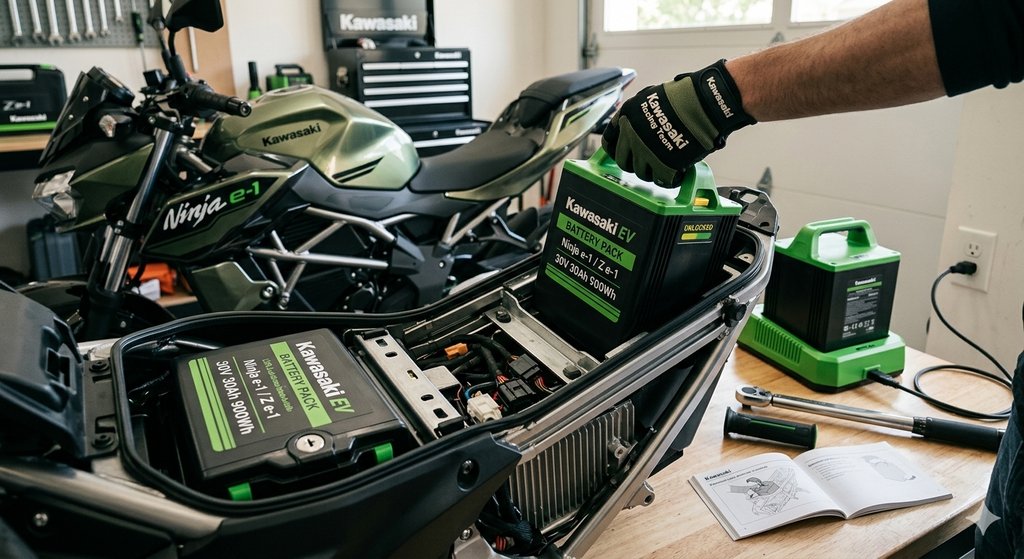
Kawasaki’s Ninja e-1 and Z e-1 use two removable lithium-ion batteries. The batteries can be removed and charged using a dedicated charger connected to a household outlet.
Kawasaki quotes approximately 72 km of riding range and around 3.7 hours for a full charge of each battery under its specified conditions.
Removable batteries can make electric ownership much easier for a rider who cannot run a charging cable to the motorcycle.
The trade-off is usually battery capacity and therefore range.
What is regenerative braking?
Regenerative braking allows an electric motor to help slow the motorcycle while recovering some energy.
When the rider slows down, the electric motor can temporarily act as a generator. Some of the motorcycle’s kinetic energy is converted back into electrical energy and returned to the battery.
For the rider, regeneration can feel similar to engine braking.
Depending on the motorcycle, regenerative braking may be:
- fixed
- adjustable
- linked to riding modes
- activated when the throttle closes
- increased during braking
The Can-Am Pulse, for example, uses both active and passive regeneration.
Regenerative braking does not replace the motorcycle’s conventional brakes.
You still have brake pads, discs, hydraulic fluid, calipers and ABS.
Do electric motorcycles require less maintenance?
Generally, yes.
An electric motorcycle does not have a gasoline engine, so many familiar service items disappear.
You usually do not have:
- engine oil changes
- engine oil filters
- spark plugs
- valve-clearance adjustments
- fuel injectors
- carburetors
- fuel pumps
- fuel filters
- exhaust systems
- engine air-intake maintenance
That can reduce both service time and the number of routine consumables.
But an electric motorcycle still has plenty of parts that wear.
What maintenance does an electric motorcycle still need?
Tires
Electric motorcycles use conventional motorcycle tires.
Torque, weight, riding style and tire pressure still affect wear.
Brakes
Brake pads, discs, brake fluid, calipers and ABS components still need inspection and service.
Regenerative braking may reduce friction-brake use in some situations, but it does not eliminate brake maintenance.
Suspension
Fork seals, fork oil, shocks, steering bearings and suspension linkages still exist.
Wheels and bearings
Wheel bearings, steering-head bearings and other chassis components still require inspection.
Final drive
The final drive depends on the motorcycle.
Some use belts. Others use chains.
Zero uses a Gates belt on the SR/F, while the Can-Am Pulse uses a protected chaincase with an automatic tensioner.
Cooling systems
Do not assume an electric motorcycle has no coolant simply because it has no combustion engine.
Some motorcycles use liquid cooling to manage battery and electronic temperatures.
The 2026 Can-Am Pulse, for example, uses liquid cooling for its battery, inverter and onboard charger.
Electrical and electronic systems
This is where electric motorcycle servicing becomes very different.
Diagnosis may involve:
- battery-management systems
- high-voltage wiring
- temperature sensors
- charging hardware
- motor controllers
- electronic communication networks
- fault codes
- firmware
- software updates
The mechanical workload may be smaller, but the importance of accurate diagnosis increases.
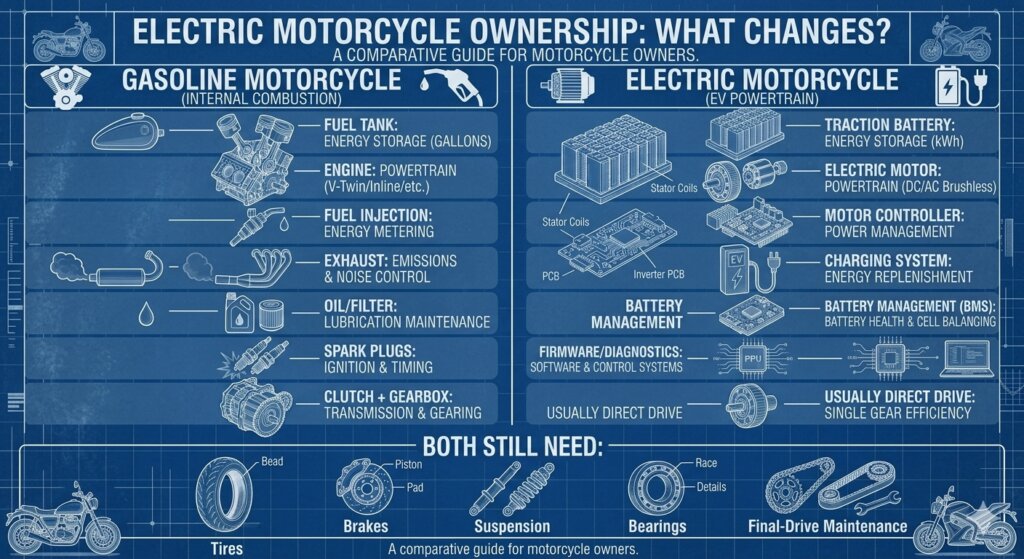
Electric vs gasoline motorcycle maintenance
| Maintenance item | Gasoline motorcycle | Electric motorcycle |
|---|---|---|
| Engine oil | Usually | Normally no |
| Oil filter | Usually | Normally no |
| Spark plugs | Yes | No |
| Valve adjustment | Some engines | No |
| Fuel system | Yes | No |
| Exhaust system | Yes | No |
| Engine air filter | Usually | No combustion intake |
| Tires | Yes | Yes |
| Brake maintenance | Yes | Yes |
| Suspension | Yes | Yes |
| Final drive | Yes | Yes |
| Cooling system | Some models | Some models |
| Electronic diagnostics | Increasingly common | Very important |
| Traction battery diagnostics | No | Yes |
| Software and firmware | Increasingly common | Often important |
| High-voltage safety procedures | No | Yes |
The key difference is straightforward:
Electric motorcycles remove many routine engine jobs, but they add battery, charging and high-voltage systems that require a different kind of knowledge.
Do electric motorcycles need software updates?
Increasingly, yes.
Motorcycles have been gaining electronic systems for years, but electrification makes software especially important because battery management and propulsion are electronically controlled.
Zero provides a useful current example.
An August 2026 firmware release added access to battery state-of-health data through dealer diagnostic equipment. The same update addressed battery detection, state-of-charge calculations and range-estimation behavior.
That shows how motorcycle troubleshooting is changing.
A problem that looks mechanical to the rider may actually involve a sensor, battery-management system, control module or software issue.
How long does an electric motorcycle battery last?
There is no universal answer.
A lithium-ion battery gradually loses some capacity as it ages.
How quickly that happens depends on factors such as:
- battery chemistry
- temperature
- age
- number of charge cycles
- storage conditions
- charging habits
- how deeply the battery is regularly discharged
- battery-management strategy
A five-year-old battery does not automatically need replacing, and two batteries of the same age may not have identical remaining capacity.
Battery warranty is therefore worth checking when comparing motorcycles.
Zero currently lists a five-year power-pack warranty on the SR/F in applicable markets. LiveWire also offers separate multi-year battery coverage on its motorcycles.
What happens as the battery ages?
Usually, usable capacity gradually decreases.
If a motorcycle originally delivered 100 miles under particular conditions, an older battery with reduced capacity may no longer achieve the same distance.
This is one reason battery condition can matter more than odometer mileage when evaluating a used electric motorcycle.
Are electric motorcycles cheaper to maintain?
They can be, especially when comparing routine maintenance.
You may eliminate years of spending on engine oil, filters, spark plugs, valve services and fuel-system maintenance.
But maintenance cost is only one part of ownership cost.
You also need to consider:
- purchase price
- electricity
- insurance
- tires
- brake and suspension maintenance
- charging equipment
- dealer labor
- battery condition
- parts availability
- depreciation
So there is no reliable rule that every electric motorcycle will automatically be cheaper to own than every gasoline motorcycle.
The answer depends on the motorcycles being compared and how they are used.
Is electricity cheaper than gasoline for a motorcycle?
Often, but the difference varies enormously by location.
Electricity prices differ by country, region, time of day and charging network.
Gasoline prices also change constantly.
Home charging is usually the most predictable way to calculate energy cost because you know your electricity tariff.
Public fast charging can cost considerably more.
If running cost is important to your buying decision, calculate it rather than relying on a general claim:
Battery capacity × electricity price = approximate cost of a full charge
Then compare that with the real range you expect to get.
Are electric motorcycles reliable?
Electric motors have far fewer moving components than internal-combustion engines.
That removes many possible mechanical failure points.
There are no pistons, valves, camshafts, spark plugs or fuel injectors involved in propulsion.
But motorcycle reliability includes much more than the motor.
An electric motorcycle also depends on:
- the traction battery
- battery-management electronics
- charging hardware
- sensors
- controllers
- wiring
- software
- brakes
- suspension
- bearings
- final-drive components
For that reason, asking whether electric motorcycles are reliable is a little like asking whether gasoline motorcycles are reliable.
The useful question is:
How reliable is this particular model and generation?
Look at owner experience, recalls, parts availability, battery warranty, known problems and manufacturer support.
Are electric motorcycles good for commuting?
This is probably where electric motorcycles make the easiest case.
Imagine your daily ride is 20 miles each way.
Your motorcycle has a reliable real-world range of 100 miles, and you can charge it at home every night.
Range becomes almost irrelevant during normal use.
You leave home with a charged motorcycle, ride to work, ride back and plug it in.
Electric motorcycles can be particularly convenient when:
- your daily mileage is predictable
- you have home or workplace charging
- much of your riding is urban
- you do not need several hundred miles of range in one day
- you value low-speed ease and immediate acceleration
For commuting, ask:
Can this motorcycle complete my normal day with a comfortable reserve?
That question is more useful than asking for the longest possible advertised range.
Are electric motorcycles good for long-distance touring?
This is where the calculation gets harder.
Long-distance riders should look carefully at:
- sustained highway range
- charging speed
- charging connector
- charger availability along the route
- charging-station reliability
- luggage
- passenger weight
- elevation
- weather
- how much time they are willing to spend charging
A motorcycle with 150 miles of city range may not provide anything close to that at continuous highway speed.
Touring is possible, particularly on motorcycles with faster charging, but route planning matters far more than it does on a gasoline motorcycle.
If your idea of a normal riding day is 500 highway miles through remote areas, a gasoline motorcycle remains considerably easier to refuel.
What should you check before buying a used electric motorcycle?
Buying a used electric motorcycle adds several checks to the normal used-bike inspection.
1. Battery condition
Ask whether battery state-of-health information is available.
Do not judge the battery simply by the motorcycle’s mileage.
2. Real charging test
If possible, connect the motorcycle to a charger.
Confirm that charging begins correctly and that there are no warnings.
3. Remaining battery warranty
Check the original in-service date and manufacturer warranty terms.
4. Warning lights and fault codes
Do not assume a warning light is an inexpensive sensor problem.
Electronic and battery faults can require proper diagnosis.
5. Software and firmware
Check whether required or recommended updates have been performed.
6. Charging connector
Inspect it for damage, contamination or signs of overheating.
7. Range
Ask what range the current owner actually gets under normal riding conditions.
8. Conventional motorcycle components
You still need to inspect:
- tires
- brakes
- wheel bearings
- steering
- suspension
- final drive
- chassis condition
- accident damage
9. Parts and service support
This can be especially important for discontinued or low-volume electric motorcycles.
A technically impressive motorcycle can become difficult to own if replacement parts and specialist support disappear.
Can you work on an electric motorcycle yourself?
Some jobs are familiar to anyone who has worked on motorcycles.
Depending on your experience and the specific model, you may be able to handle tasks such as:
- inspecting tires
- checking brake pads
- changing brake fluid
- maintaining a chain
- inspecting a drive belt
- servicing suspension
- replacing some chassis components
- basic low-voltage electrical work
High-voltage systems are different.
The traction battery can store dangerous amounts of electrical energy even when the motorcycle is switched off.
Work involving components such as the high-voltage battery, inverter, motor controller or high-voltage wiring should follow the manufacturer’s specified isolation and safety procedures.
A normal 12-volt motorcycle electrical approach is not enough.
Do electric motorcycles need service manuals?
Yes, particularly when diagnosis or high-voltage systems are involved.
Electric motorcycles may have fewer conventional engine components, but accurate technical information is still needed for:
- wiring diagrams
- diagnostic codes
- battery procedures
- charging-system diagnosis
- component testing
- torque specifications
- disassembly
- safety procedures
- cooling systems
- final-drive service
The nature of repair changes. The need for correct information does not.
What are some current electric motorcycles?
The category now covers very different types of motorcycles rather than one standard formula.
Zero SR/F
The Zero SR/F is a full-size electric road motorcycle with a large integrated battery, belt drive and high-performance motor.
Zero currently lists up to 176 miles of city range, 117 miles of high-speed highway commuting range, 140 lb-ft of torque and 111 hp.
LiveWire ONE
The LiveWire ONE takes another full-size performance approach.
It offers DC fast charging, 100 hp and a manufacturer-rated 146-mile city range.
Can-Am Pulse
The Can-Am Pulse is more urban-focused.
For 2026, Can-Am quotes up to 100 miles of city range and 80 miles combined, with Level 2 charging from 20 to 80 percent in about 50 minutes.
Kawasaki Ninja e-1 and Z e-1
Kawasaki has taken a smaller-capacity approach with removable batteries.
The Ninja e-1 and Z e-1 use two removable batteries and target shorter everyday journeys rather than long-distance travel.
These motorcycles demonstrate why broad statements about electric bikes can be misleading.
A lightweight commuter with removable batteries and a 500-pound performance motorcycle with a large integrated battery solve very different problems.
| Model | City range | Highway/combined range | Charging approach | Drivetrain |
|---|---|---|---|---|
| Zero SR/F | 176 mi | 117 mi high-speed highway | AC rapid charging | Belt |
| LiveWire ONE | 146 mi | 95 mi combined | DC fast charging | Belt |
| Can-Am Pulse | 100 mi | 80 mi combined | Level 1/2 | Enclosed chain |
| Kawasaki Ninja e-1 | Short-range commuter | Manufacturer test dependent | Removable batteries | Chain |
Specifications shown are manufacturer figures under different test procedures and should not be treated as directly comparable real-world range tests.
Electric motorcycle vs gasoline motorcycle: which is better?
Neither is automatically better.
The more useful question is which powertrain suits the riding you actually do.
An electric motorcycle may make more sense if:
- you have easy access to charging
- your daily mileage is predictable
- you ride mainly in or around a city
- you like immediate throttle response
- you want fewer conventional engine services
- most trips fit comfortably inside the motorcycle’s real range
A gasoline motorcycle may make more sense if:
- you regularly ride very long distances
- you tour through remote areas
- you cannot charge at home or work
- you need to refuel quickly almost anywhere
- you prefer a clutch and manual gearbox
- the electric motorcycles available to you are too expensive
There is no need to turn the choice into an ideological argument.
Look at your riding.
Then choose the technology that makes that riding easier.
Frequently asked questions
Do electric motorcycles need oil changes?
Most battery-electric motorcycles do not need conventional engine-oil changes because they have no internal-combustion engine. Some models can still use lubricants in reduction drives, transmissions or other components, so always check the specific maintenance schedule.
Do electric motorcycles have spark plugs?
No. Electric motorcycles do not use spark plugs because they do not burn fuel.
Do electric motorcycles have a clutch?
Most current electric motorcycles do not use a conventional manual clutch.
Do electric motorcycles have gears?
Most use a single-speed drive, although designs can vary.
Can you charge an electric motorcycle from a normal outlet?
Many models can. Charging speed and electrical requirements vary by motorcycle and market.
Can an electric motorcycle use an EV car charger?
Sometimes. Compatibility depends on the motorcycle, charging connector and type of charging station.
Does regenerative braking charge the battery?
Yes, it can return some energy to the battery while slowing the motorcycle. It cannot recover all of the energy originally used to accelerate.
Does regenerative braking replace normal brakes?
No. Electric motorcycles still use conventional friction brakes.
Are electric motorcycles maintenance-free?
No. They eliminate many gasoline-engine maintenance jobs but still require tire, brake, chassis, suspension and final-drive maintenance along with inspection of their electrical systems.
What happens if an electric motorcycle runs out of battery?
The motorcycle can no longer propel itself and will need to reach a compatible charging source. Unlike carrying a small container of fuel, restoring usable range usually requires access to electricity and some charging time.
Does cold weather affect electric motorcycle range?
It can. Battery performance and usable range can decrease in colder conditions. The size of the effect varies with battery technology, temperature and motorcycle design.
Is a used electric motorcycle worth buying?
It can be. Pay particular attention to battery health, warranty coverage, charging operation, software support, parts availability and actual range.
So, does an electric motorcycle make sense for you?
For some riders, absolutely.
If you commute 30 or 40 miles a day, charge at home and rarely ride several hundred miles in one trip, an electric motorcycle can fit naturally into everyday life.
If you regularly cross remote areas, cover huge highway distances or have nowhere convenient to charge, the limitations become harder to ignore.
That is why electric motorcycles are difficult to judge with sweeping statements about range, cost or reliability.
The useful questions are personal and practical:
How far do you actually ride?
Where can you charge?
How quickly does the motorcycle recharge?
What range does it deliver at the speeds you normally ride?
How healthy will the battery be if you buy used?
What maintenance and support does that particular model require?
Answer those questions and the decision becomes much easier.
Electric motorcycles do not need to replace every gasoline motorcycle to be useful. They simply need to work well for the rider and the journeys they are being asked to make.