
Diesel motorcycles are one of the rarest branches of motorcycle engineering. While diesel engines dominate many trucks, commercial vehicles and military applications, they have never achieved widespread adoption on two wheels.
A small number of notable diesel-powered motorcycles have nevertheless reached production or military service, including the Royal Enfield Diesel and Taurus, the Kawasaki KLR650-based HDT M1030M1 military motorcycle, and the Track T-800CDI.
Diesel engines can offer excellent fuel economy, strong low-rpm torque and long operating ranges, but their extra weight, vibration, emissions challenges and relatively low power-to-weight ratio have limited their appeal for motorcycles.
This guide explores the history of diesel motorcycles, how they work, their advantages and disadvantages, and why they remain such an unusual part of motorcycling.

History of Diesel Motorcycles
Experiments with diesel-powered motorcycles have existed for decades, but very few progressed to large-scale production.
One of the most important examples arrived in India. In 1993, Royal Enfield introduced the Enfield Diesel, using a 325 cc diesel engine installed in the familiar Bullet chassis. Royal Enfield describes it as the world’s first and only mass-manufactured diesel motorcycle. A heavier-duty version known as the Taurus followed.
The motorcycle prioritized economy rather than speed. Royal Enfield promoted fuel consumption of approximately 70 km/l, making the diesel model particularly attractive to riders and businesses covering long distances while keeping fuel costs low.

Notable Diesel Motorcycles
Although diesel motorcycles have remained rare, several models demonstrate the different reasons manufacturers and engineers experimented with diesel power.
Royal Enfield Diesel and Taurus
The Royal Enfield Diesel is the best-known mass-produced example. Introduced in India in the early 1990s, it combined a 325 cc diesel engine with a Bullet-based chassis. Its modest power output was offset by exceptional fuel economy, making it more of a practical workhorse than a performance motorcycle.
HDT M1030M1 Military Motorcycle
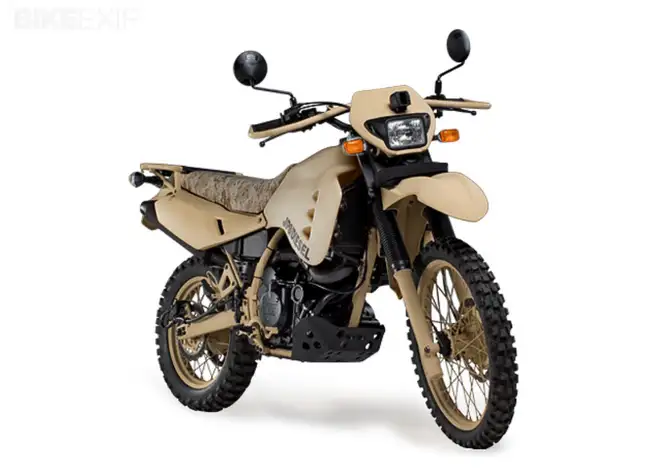
Another important diesel motorcycle was developed specifically for military use. Hayes Diversified Technologies converted the Kawasaki KLR650 platform into the M1030M1, a multi-fuel motorcycle capable of operating on diesel, JP-8 aviation fuel and other fuels used by military vehicles.
The 611 cc military version produced around 30 PS, could exceed 90 mph and was rated at 96 mpg at 55 mph. Its real advantage was logistical: military motorcycles could use the same fuel supply as other vehicles rather than requiring gasoline to be transported separately.
Track T-800CDI
The Dutch-built Track T-800CDI took a different approach. It used an approximately 800 cc turbo-diesel three-cylinder engine combined with an automatic continuously variable transmission and shaft drive.
Its design emphasized torque, fuel economy and long-distance capability rather than outright performance, but production remained extremely limited.
The Evolution of Diesel Motorcycles
Over the years, diesel motorcycles have undergone significant evolution and refinement. Advances in engineering, materials, and technology have transformed these machines from rugged experiments into viable and functional motorcycles.
Performance Improvements: Early diesel motorcycles were frequently criticized for their limited performance and acceleration. Modern diesel engines, on the other hand, have achieved substantial improvements in power output, torque delivery, and overall rideability. These advancements have made diesel motorcycles competitive in terms of performance.
Efficiency and Fuel Economy: One of the hallmarks of diesel motorcycles is their exceptional fuel efficiency. Diesel engines inherently provide a higher thermal efficiency compared to gasoline engines, resulting in reduced fuel consumption. This efficiency translates into extended riding ranges, making diesel motorcycles practical for long-distance touring.
Emission Control: Diesel engines have faced scrutiny due to their emissions. To address environmental concerns, modern diesel motorcycles are equipped with emission control technologies, such as diesel particulate filters (DPF) and selective catalytic reduction (SCR) systems. These measures help reduce harmful emissions while maintaining engine efficiency.
Noise Reduction: Early diesel motorcycles were often associated with loud and clattering operation. Improved sound insulation and smoother engine designs have made modern diesel motorcycles quieter and more rider-friendly.
In addition to improving traditional diesel motorcycles, the industry may witness the emergence of hybrid models that combine diesel engines with electric powertrains. These hybrid diesel-electric motorcycles could offer the benefits of both worlds—diesel’s torque and efficiency and electric’s environmental friendliness and versatility.
The Advantages of Diesel Motorcycles
Diesel motorcycles offer several distinct advantages that set them apart from their gasoline-powered counterparts:
- Low-RPM Torque: Diesel engines can produce strong torque at relatively low engine speeds, giving them useful pulling power without requiring high RPM. This characteristic can work well for heavily loaded, utility and long-distance motorcycles, although the additional weight of a diesel engine can limit outright acceleration and performance.
- Fuel Efficiency: As mentioned earlier, fuel efficiency is a standout feature of diesel motorcycles. Their ability to extract more energy from each gallon of fuel results in longer riding ranges and fewer stops at the fuel station.
- Durability: Diesel engines are generally engineered to operate under high compression and sustained loads. However, maintenance requirements and service intervals depend on the specific motorcycle and engine design, so diesel power does not automatically mean lower maintenance.
- Availability of Fuel: Diesel fuel is widely available in many parts of the world, making it a practical choice for riders who venture into remote or less-traveled areas.

Why Are Diesel Motorcycles So Rare?
Despite their fuel-economy advantages, diesel engines present several problems when installed in motorcycles.
Weight: Diesel engines generally need stronger components to withstand their higher compression ratios. Extra engine weight is particularly undesirable on a motorcycle, where mass has a major effect on handling and acceleration.
Power-to-weight ratio: Motorcycles usually benefit from lightweight engines capable of producing high power at high RPM. Diesel engines traditionally favor low-speed torque and efficiency instead.
Vibration and refinement: Single-cylinder and small diesel engines can produce considerable vibration, which can make them less comfortable than comparable gasoline motorcycle engines.
Emissions: Modern emissions regulations make developing a small, lightweight and cost-effective motorcycle diesel engine increasingly difficult.
Cost and demand: Developing a dedicated motorcycle diesel engine is expensive, while consumer demand remains extremely small. Most manufacturers therefore concentrate on gasoline and increasingly electric powertrains.
These compromises explain why diesel motorcycles remain fascinating engineering experiments and specialized machines rather than mainstream alternatives to gasoline motorcycles.
In addition to improving traditional diesel motorcycles, the industry may witness the emergence of hybrid models that combine diesel engines with electric powertrains. These hybrid diesel-electric motorcycles could offer the benefits of both worlds—diesel’s torque and efficiency and electric’s environmental friendliness and versatility.
Are Diesel Motorcycles Still Relevant?
Diesel motorcycles occupy a small but fascinating place in motorcycle history.
The Royal Enfield Diesel demonstrated how economical a simple diesel-powered motorcycle could be. The HDT M1030M1 showed why multi-fuel diesel technology could be valuable to military users, while machines such as the Track T-800CDI explored the idea of a modern long-range diesel touring motorcycle.
Their fuel economy, low-rpm torque and range are attractive qualities, but additional weight, vibration, emissions requirements and limited performance have prevented diesel motorcycles from becoming mainstream.
For most riders, gasoline and electric motorcycles now provide more practical solutions. Diesel motorcycles remain important primarily as unusual engineering achievements and examples of how manufacturers have experimented with alternative motorcycle powertrains.