
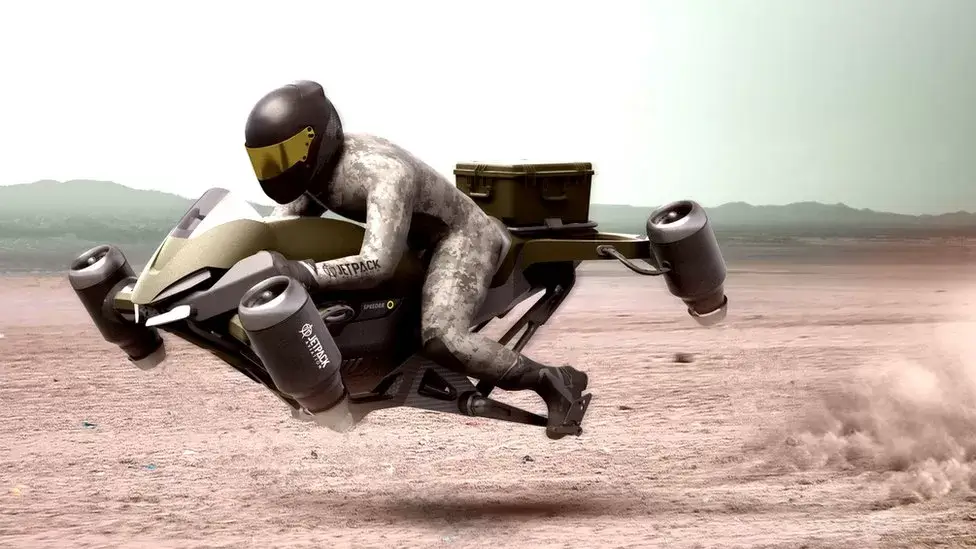
Jet-powered motorcycles are some of the rarest and most extreme machines ever built on two wheels.
Some use direct jet thrust to propel the motorcycle forward, while others use a gas turbine to mechanically drive the rear wheel. That distinction matters because machines such as Jet Reaction and the MTT Y2K use very different forms of propulsion.
This guide explains how jet motorcycles work, how they differ from turbine-powered motorcycles, and looks at some of the most famous examples.
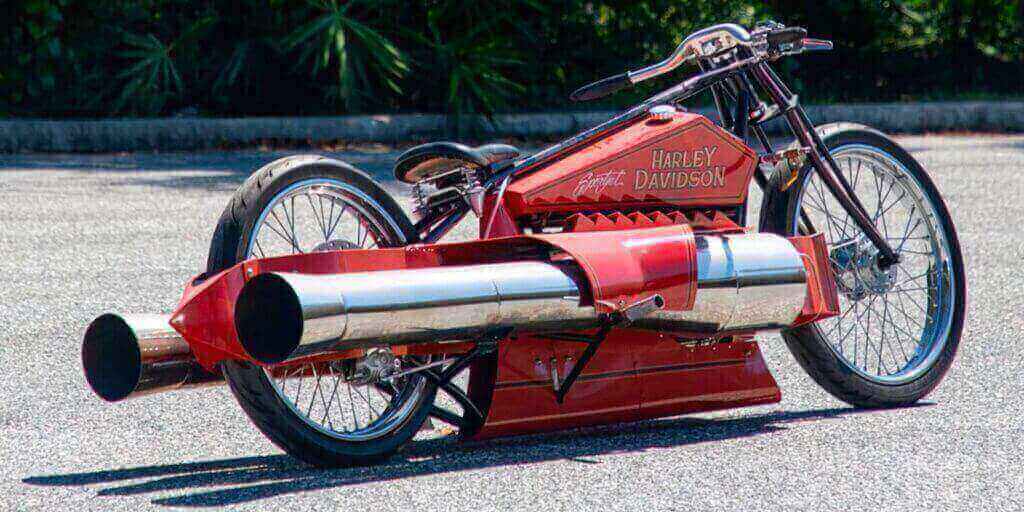
What Is a Jet-Powered Motorcycle?
A true jet-powered motorcycle uses a jet engine to produce direct thrust.
Air enters the engine, is compressed, mixed with fuel and burned. The resulting hot gases are expelled through the rear of the engine at high speed, pushing the motorcycle forward.
Unlike a conventional motorcycle engine, the jet does not need to mechanically turn the rear wheel.
This makes a true jet motorcycle closer in propulsion principle to a jet aircraft than to a conventional superbike.
Jet-Powered vs Turbine-Powered Motorcycles
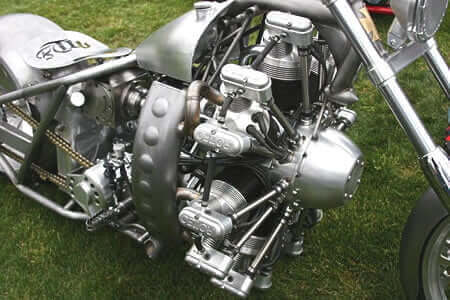
The terms are often used interchangeably, but they describe different systems.
Jet-powered motorcycles use exhaust thrust to propel the motorcycle directly.
Turbine-powered motorcycles use a gas turbine to produce shaft power, which is transferred through the drivetrain to the rear wheel.
The MTT Y2K and MTT 420RR are turbine-powered motorcycles, not direct-thrust jet bikes.
Rocket-powered motorcycles form a third category because they generate thrust using a rocket motor rather than an air-breathing jet engine.
How Does a Jet Motorcycle Work?
A jet engine works by accelerating gases rearward.
The process is relatively simple in principle:
- Air enters the engine.
- A compressor increases the air pressure.
- Fuel is added and burned.
- Hot gases expand rapidly.
- The gases are expelled through the exhaust.
- The resulting reaction force pushes the motorcycle forward.
Some experimental jet motorcycles also use an afterburner to create additional thrust.
The system works well for extreme speed, but it is poorly suited to ordinary road riding because of heat, noise, fuel consumption and unusual throttle response.
Jet Reaction
One of the best-known genuine jet motorcycles is Jet Reaction, developed by British engineer Richard Brown.
The motorcycle was created as a land-speed record challenger and used a helicopter gas-turbine engine converted to operate as an afterburning turbojet.
Unlike a normal motorcycle, Jet Reaction did not rely on the rear wheel to provide propulsion. The jet engine created direct thrust.
Brown designed the machine with the goal of reaching approximately 400 mph.
Stopping from such speeds also required specialist equipment. Jet Reaction used a parachute to reduce speed before conventional braking became effective.

Did Jet Reaction Break the Sound Barrier?
No.
Jet Reaction has sometimes been incorrectly described as a supersonic motorcycle, but it never broke the sound barrier.
It was designed as a motorcycle land-speed record challenger with a target around 400 mph, still far below the speed of sound.
No motorcycle has achieved a verified supersonic motorcycle land-speed record.
MTT Y2K Turbine Superbike
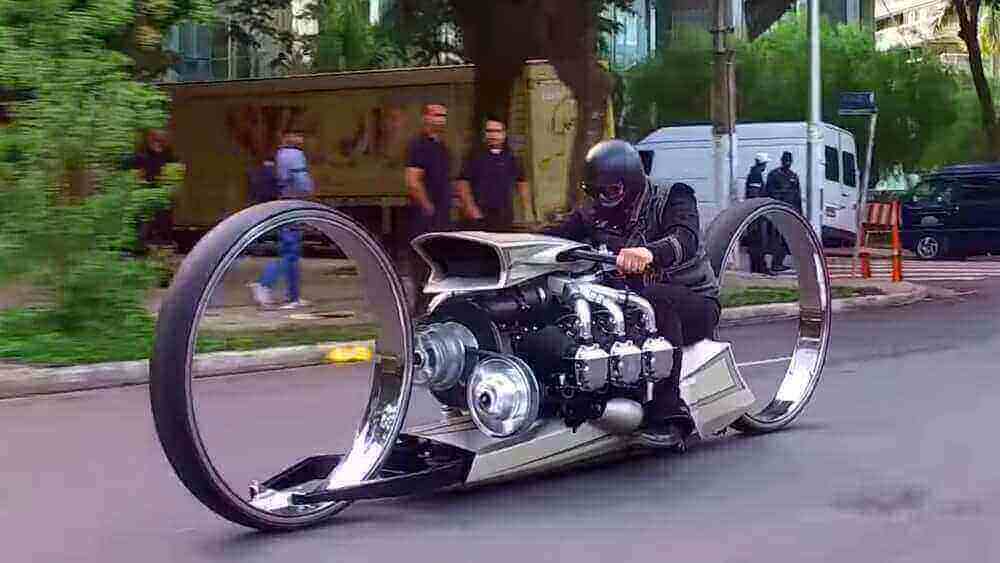
The MTT Y2K is one of the most famous turbine-powered motorcycles ever produced.
Marine Turbine Technologies equipped it with a Rolls-Royce-Allison gas turbine derived from aviation applications.
Unlike Jet Reaction, the turbine does not simply fire exhaust behind the motorcycle. It generates shaft power that is mechanically transferred to the rear wheel.
According to MTT, the Y2K produced more than 320 horsepower and 425 lb-ft of torque and was clocked at 227 mph.
The Y2K was also developed as a road-going production motorcycle rather than purely as a land-speed machine.

MTT 420RR
MTT later developed the 420RR, a more powerful evolution of its turbine-motorcycle concept.
The 420RR uses a Rolls-Royce M250-C20B turbine producing a claimed 420 horsepower and 500 lb-ft of torque.
MTT lists a gearing-limited maximum speed of 273 mph.
Like the Y2K, the 420RR transfers turbine power mechanically to the rear wheel rather than using direct jet thrust.

For more extreme high-speed machines, see our guide to the 10 fastest motorcycles in the world.
What About the Ack Attack?
The Ack Attack is one of the most important machines in motorcycle land-speed history, but it is not jet-powered.
It uses two turbocharged Suzuki Hayabusa engines that mechanically drive the motorcycle.
In 2010, Rocky Robinson rode Ack Attack to an FIM motorcycle land-speed record of 376.363 mph (605.698 km/h).

Ack Attack is useful as a comparison because it shows how extreme speeds can also be achieved using conventional piston engines and wheel drive.
Its twin Hayabusa engines also provide a natural link to our collection of Suzuki Hayabusa service and repair manuals.
Why Are Jet-Powered Motorcycles So Rare?
Jet-powered motorcycles are extremely impractical for normal road use.
Heat
Jet engines generate enormous heat. Packaging that safely around a rider, fuel tank, tires and motorcycle chassis is difficult.
Fuel Consumption
Jet and turbine engines are generally inefficient at the low speeds and frequent throttle changes encountered during everyday riding.
Noise
Jet engines produce extreme levels of noise, making road use difficult from both a practical and regulatory perspective.
Throttle Response
Gas turbines do not respond to throttle inputs in exactly the same way as conventional motorcycle engines. Turbine spool-up can make low-speed control less predictable.
Cost
Aircraft-derived turbine engines are highly specialized and expensive to manufacture and maintain.
Safety
A direct-thrust jet engine also produces a dangerous high-temperature exhaust stream behind the motorcycle, making normal road traffic essentially impossible.
For these reasons, true jet motorcycles remain experimental machines rather than practical transportation.
Are Turbine Motorcycles More Practical?
Turbine-powered motorcycles such as the MTT Y2K are more practical than direct-thrust jet motorcycles because the turbine drives the rear wheel.
This allows them to behave more like conventional motorcycles at low speeds.
However, they are still expensive, mechanically unusual and extremely rare.
Turbine motorcycles are better understood as engineering showcases rather than realistic alternatives to conventional motorcycles.
Jet Motorcycles and the Land-Speed Record
The recognized FIM motorcycle land-speed record is 376.363 mph, achieved by Rocky Robinson on the Ack Attack in 2010.
Ack Attack is not jet-powered. It uses two turbocharged Suzuki Hayabusa engines.
A jet-powered motorcycle could theoretically exceed this speed, but it would still need to meet the relevant land-speed record rules and complete the required timed runs.
The challenge is not simply producing enough thrust. Stability, aerodynamics, braking, wheel design and rider safety all become increasingly difficult as speeds rise.
Could a Motorcycle Break the Sound Barrier?
In theory, a thrust-powered motorcycle could be designed to approach supersonic speeds.
In practice, the engineering challenge would be enormous.
The speed of sound is roughly 767 mph at sea level under standard conditions, although it varies with atmospheric conditions.
That is more than twice the current motorcycle land-speed record.
At those speeds, aerodynamic stability, shock waves, wheel loads and even minor steering inputs become major engineering problems.
No motorcycle has yet achieved a verified supersonic record.
Famous Jet and Turbine Motorcycles at a Glance
| Motorcycle | Propulsion | Notable Figure |
|---|---|---|
| Jet Reaction | Direct jet thrust | Designed for around 400 mph |
| MTT Y2K | Turbine driving rear wheel | 227 mph |
| MTT 420RR | Turbine driving rear wheel | Claimed 273 mph |
| Ack Attack | Twin turbo Hayabusa engines | 376.363 mph record |
The Future of Jet-Powered Motorcycles
Jet-powered motorcycles are unlikely to become mainstream road vehicles.
Their heat, fuel consumption, noise, cost and operating characteristics make them poorly suited to everyday riding.
Their future is more likely to remain connected to experimental engineering and land-speed competition.
Turbine motorcycles such as the MTT Y2K and 420RR occupy a slightly different position because they demonstrate that aircraft-derived turbine technology can be adapted to a functioning road motorcycle.
Both remain fascinating examples of how engineers have explored alternatives to conventional motorcycle engines.
For more unusual motorcycle technology, explore our guides to diesel motorcycles and the fastest motorcycles in the world, or browse our collection of motorcycle service and repair manuals.