
Kawasaki KX125 / KX250 / KX500 Service Manual (1988-2004)
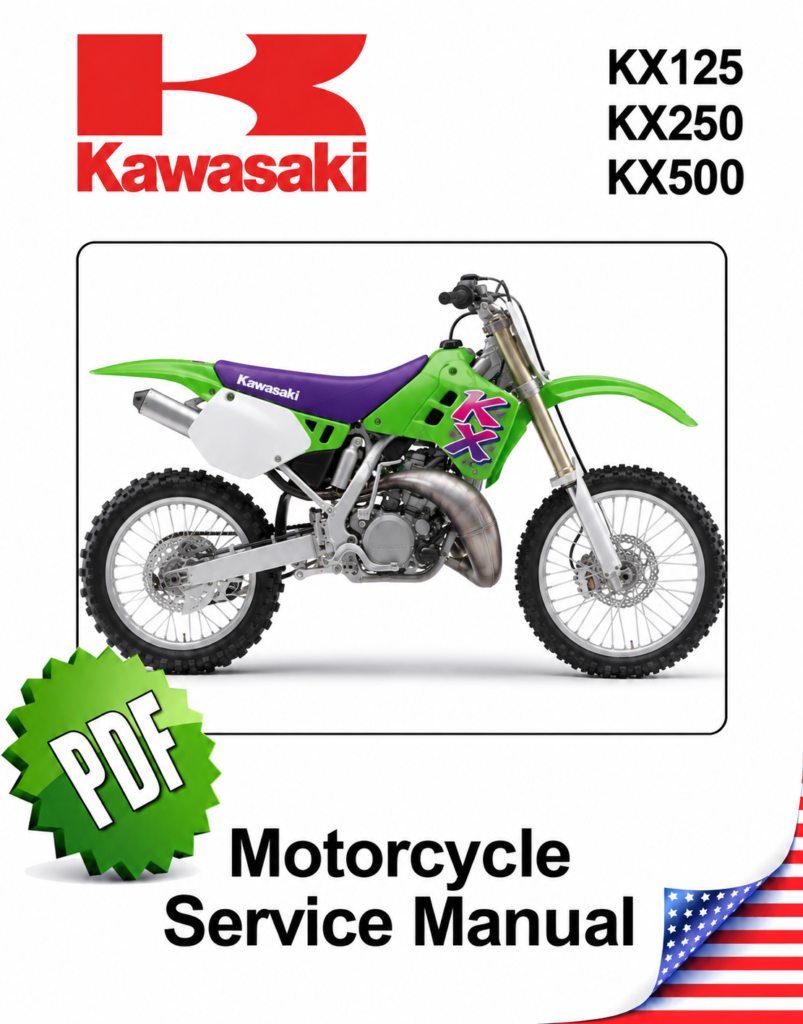

Compiled Kawasaki factory workshop service documentation for KX125-F1 (1988), KX250-F1 (1988) and KX500-D1 (1988), followed by the 1989 KX125-G1/KX250-G1/KX500-E1 supplement, a 1990-and-later KX500-only supplement, and a supplementary 2000–2004 KX500 E12–E16 chapter. The manual is 330 pages, mainly English, unencrypted and printable, with 314 pages containing selectable/extractable text and 16 image-only or blank pages. Its source title '1988–2004' describes the combined KX500 span, NOT full 1988–2004 factory coverage of KX125 or KX250. The KX125/KX250 instructions and models in this file are specifically 1988–1989. The source documents base 1988 KX125 124cc 56.0×50.6mm Keihin PWK35 6-speed; KX250 249cc 67.4×70.0mm Keihin PWK39 5-speed; KX500 499cc 86.0×86.0mm Keihin PWK39 5-speed. Engine fuel/jetting, compression and other specifications vary in later KX500 E-series supplements and must not be generalized to every year. Factory workshop coverage includes model identification, maintenance, torque, throttle/carburetor/reed valves, cooling and water pump, Kawasaki KIPS exhaust-power-valve synchronization, cylinder head/piston/cylinder, exhaust and silencer, clutch, kickstarter, engine installation/removal, crankshaft/gearbox overhaul, wheels and spokes, chain and sprockets, hydraulically actuated disc-brake systems, front fork and rear Uni-Trak suspension, steering and CDI electrical systems and wiring. The late supplement explicitly references manufacturer base service manual part no. 99924-1101-01. All page examples are from the uploaded file; seller-supplied cover date range is not independent evidence of model-by-model coverage.
About the Manual
- Manual type
- Factory Service Manual
- Years covered*
- 1988–2004
- Pages
- 330
- Language
- English
- Format
- Main sections
- 29
- Searchable PDF
- Yes
- Printable PDF
- Yes
- File size
- 33.9 MB
- Delivery
- Digital download
* Indicative only. Please do your own research and confirm compatibility with your exact motorcycle and model year before purchasing.
Kawasaki 1988 base F1/F1/D1; 1989 G1/G1/E1; 1990–2004 E2–E16 supplements Motorcycle Details
What’s Included in the Kawasaki 1988 base F1/F1/D1; 1989 G1/G1/E1; 1990–2004 E2–E16 supplements Service Manual?
- 1988 factory KX125-F1, KX250-F1 and KX500-D1 model identification and specifications
- 1989 KX125-G1, KX250-G1 and KX500-E1 factory supplement
- 1990-onward KX500 E-series updates and 2000–2004 E12–E16 supplement
- Year-by-year KX500 1990–2004 model application and beginning frame numbers
- Factory maintenance intervals, torque specifications and cable routing
- Keihin carburetor service, throttle adjustment, fuel-level checking and jetting
- Carburetor disassembly, cleaning, air-filter servicing and reed valves
- Radiator, water pump, cooling hose, coolant and pressure checks
- Two-stroke cylinder head and compression testing procedures
- Kawasaki Integrated Power-valve System (KIPS) removal and synchronization
- Cylinder and piston removal, inspection, rings, clearances and service limits
- Expansion chamber, exhaust and silencer packing maintenance
- Right engine cover, exhaust valve advancer and primary gearing
- Wet clutch plates, springs, hub, basket and clutch-lever adjustment
- Shift selector mechanism and kickstarter overhaul
- Full engine removal, mounting and reinstallation procedures
- Crankcase splitting, crankshaft alignment, bearings and rod inspections
- Six-speed KX125 and five-speed KX250/KX500 gearbox inspection and assembly
- Transmission oil level, oil change and service limits
- Front/rear wheel removal, rim runout, spokes and wheel bearings
- Final chain drive, master link, chain tension and sprockets
- Hydraulic front and rear disc brake caliper, master cylinder and pad service
- Brake-fluid maintenance, brake hose replacement and disc measurements
- Telescopic front fork servicing, damping adjustment and fork-oil replacement
- Rear Uni-Trak linkage and rear shock absorber servicing
- Frame steering head and steering bearing service
- CDI ignition, flywheel magneto, stator and ignition-coil inspections
- Electrical wiring diagrams and year-specific KX500 ignition changes
- General lubrication, troubleshooting and appendix specifications
Preview Inside the Manual
See a selection of pages from this service manual before purchasing.
Click a sample page to enlarge it. Preview images are excerpts only; the complete manual is supplied after purchase.
Get the Complete Kawasaki 1988 base F1/F1/D1; 1989 G1/G1/E1; 1990–2004 E2–E16 supplements Service Manual
330 pages • PDF • Instant download
About the Kawasaki 1988 base F1/F1/D1; 1989 G1/G1/E1; 1990–2004 E2–E16 supplements
Kawasaki established its KX motocross identity in the 1970s, with the quarter-litre KX250 becoming a central part of its competition range. The smaller KX125 developed into the lightweight two-stroke option for riders competing in the 125 cc class, while the KX500 entered the powerful Open-class category in 1983. Each served a different kind of rider, but all were built around close-ratio manual transmissions, long-travel suspension and responsive two-stroke singles. In the early 1980s, Kawasaki steadily developed its chassis designs and engine technology in response to pressure from Honda, Yamaha and Suzuki. Liquid cooling reached the big 500 in 1985, while the KIPS exhaust-power-valve system followed in 1986. The resulting motorcycles helped build Kawasaki's reputation in professional motocross and recreational off-road competition. Dirt Bike's KX500 retrospective recounts these formative changes.
The 1988 KX125, identified as the KX125-F1, represented Kawasaki's smaller-capacity racing platform at the end of the 1980s. Its liquid-cooled, carbureted 124 cc engine used reed-valve induction and a six-speed transmission, distinguishing it from the larger motocross machines. The 1989 KX125-G1 received its own revised components while retaining the recognizable high-revving character of a 125 cc two-stroke. Small-displacement performance depended on frequent gear changes, effective exhaust tuning and lightweight handling. These late-1980s models preceded the much more dramatic 1990 KX125 generation, when Kawasaki introduced a different perimeter-frame design and substantially altered the machine's appearance. As noted in PulpMX's Kawasaki motocross history, the 1990 redesign was a major departure from the 1989 bikes. The 1988 and 1989 machines therefore mark a specific period of KX125 development, not an unchanged design spanning the 1990s.
The 1988 KX250, designated KX250-F1, competed in the 250 cc motocross class with a larger liquid-cooled reed-valve two-stroke single and a five-speed manual transmission. The period's frame geometry, single-shock Uni-Trak rear suspension and strong midrange performance were intended to balance cornering precision with acceleration out of turns. Kawasaki released the KX250-G1 for 1989 with its own year-specific revisions, retaining the basic two-stroke competition formula. The 250 class became increasingly technically demanding as competing manufacturers adopted new frames, suspension designs and engine layouts. In 1990 Kawasaki joined the movement toward perimeter-frame motocross chassis, a significant break from the 1988–1989 KX250 design. This distinction matters historically: although the KX250 name remained in use for many subsequent seasons, the engines, frames and service specifications evolved extensively rather than remaining identical to the original F1 and G1 motorcycles.
The large-capacity KX500 underwent a particularly influential redesign for 1988, identified as the D1 generation. Its 499 cc liquid-cooled two-stroke engine, KIPS exhaust-valve system and stout tubular chassis combined exceptional torque with the suspension travel required for serious off-road competition. The 1989 KX500-E1 built on that design, and the 1990 E2 adopted inverted front forks, one of the line's most conspicuous later changes. During the early 1990s the KX500 became increasingly associated with American desert racing and long-distance off-road events, where abundant torque and high-speed stability were major advantages. Changes to the ignition and crankshaft around 1992 reflected this expanding role. The line's large-capacity two-stroke motocross and desert-racing heritage is documented in contemporary retrospectives, including Australasian Dirt Bike's KX500 history.
The KX500 remained on sale through 2004, with Kawasaki identifying yearly E-series versions from KX500-E2 for 1990 through KX500-E16 for 2004. Its continued use of a carbureted 499 cc two-stroke engine and five-speed transmission was increasingly unusual as motocross competition moved toward four-stroke machinery. The reduction of the traditional 500 cc motocross class did not end the bike's appeal to desert racers, where the engine's power and durable basic architecture retained a loyal following. The KX125 and KX250, by contrast, continued to evolve along distinct development paths after 1989, with later-generation frames and engine specifications. The 1988–2004 span represents the combined historical period documented by the early three-model service literature and the later KX500 E-series updates; it should not be taken to mean that the 1988–1989 KX125 and KX250 designs remained unchanged to 2004. Related publications are listed in the Kawasaki service manual catalog.
Why Choose a Digital PDF Service Manual?
We supply service manuals as digital PDF downloads rather than printed books.
We do not offer printed manuals. Digital delivery has several practical advantages:
- Digital delivery avoids producing and shipping an additional printed copy.
- Keep your master copy clean and grease-free while you work on your motorcycle.
- Print only the specific page or pages you need for the job.
- Access the manual immediately after successful payment.
- Search the PDF to find terms, procedures and components quickly.
Related Kawasaki Service Manuals
Kawasaki 1400GTR / Concours 14 / Concours 14 ABS Service Manual (2008)
Kawasaki 1400GTR, Concours 14 and Concours 14 ABS factory service manual for 2008 ZG1400A8F/ZG1400B8F models. This 803-page searchable PDF covers maintenance, DFI, variable valve timing, KIPASS, hydraulic clutch, 6-speed transmission, Tetra Lever shaft drive, brakes, suspension and electrical systems.

Kawasaki Bajaj Pulsar 200 NS / Rouser 200 NS Service Manual (2013–2014)
Kawasaki-Bajaj Pulsar 200 NS and Rouser 200 NS factory service manual for 2013 BR200AD and 2014 BR200AE models. This 411-page searchable PDF covers maintenance, carburetor fuel system, liquid-cooled 200 cc engine, clutch, 6-speed transmission, chain drive, brakes, suspension and electrical systems.
Kawasaki EN500 / Vulcan 500 LTD Service Manual (1996–2008)
Kawasaki EN500 / Vulcan 500 LTD factory service manual for 1996–2008 C-series models. This 351-page searchable PDF covers maintenance, twin Keihin carburetors, the 498 cc DOHC engine, 6-speed transmission, chain drive, brakes, suspension and electrical systems.
Kawasaki ER-5 Service Manual (2001–2005)
Kawasaki ER-5 factory service manual for 2001–2005 ER500C/D models. This 334-page searchable PDF covers the 498 cc parallel-twin engine, Keihin carburetors, six-speed transmission, chain drive, chassis, brakes and electrical systems.
Get the Kawasaki 1988 base F1/F1/D1; 1989 G1/G1/E1; 1990–2004 E2–E16 supplements Service Manual
Click the Buy Now button below to get the complete PDF manual.