
Kawasaki ER-5 Service Manual (2001–2005)
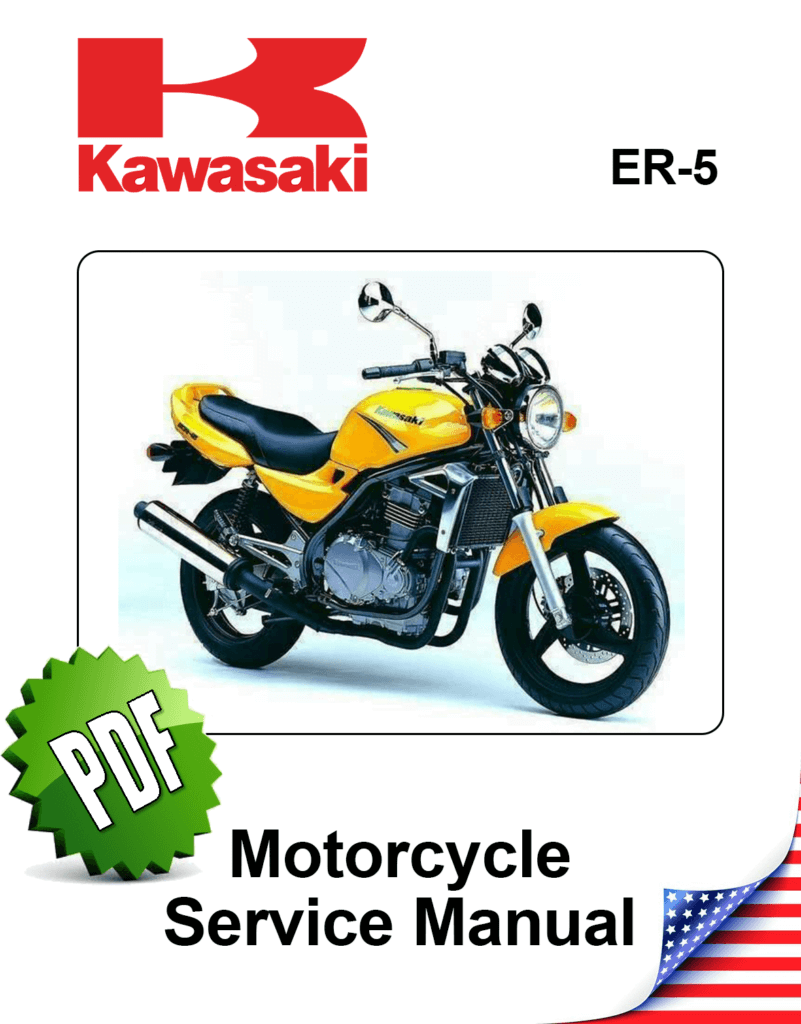

Kawasaki ER-5 factory service manual for the 2001–2005 ER500C/D model family. This 334-page searchable PDF covers general information and periodic maintenance, Keihin CVK34 carburetors, cooling, engine top end, clutch, lubrication, engine removal, crankshaft and six-speed transmission, wheels and tires, chain final drive, brakes, suspension, steering, frame, electrical systems and appendix data.
About the Manual
- Manual type
- Factory Service Manual
- Years covered*
- 2001–2005
- Pages
- 334
- Language
- English
- Format
- Main sections
- 16
- Searchable PDF
- Yes
- Printable PDF
- Yes
- File size
- 5.4 MB
- Delivery
- Digital download
* Indicative only. Please do your own research and confirm compatibility with your exact motorcycle and model year before purchasing.
Kawasaki ER-5 2nd Generation (ER500C/D) Motorcycle Details
What’s Included in the Kawasaki ER-5 2nd Generation (ER500C/D) Service Manual?
- General Information
- Fuel System
- Cooling System
- Engine Top End
- Clutch
- Engine Lubrication System
- Engine Removal/Installation
- Crankshaft/Transmission
- Wheels/Tires
- Final Drive
- Brakes
- Suspension
- Steering
- Frame
- Electrical System
- Appendix
Preview Inside the Manual
See a selection of pages from this service manual before purchasing.
Click a sample page to enlarge it. Preview images are excerpts only; the complete manual is supplied after purchase.
Get the Complete Kawasaki ER-5 2nd Generation (ER500C/D) Service Manual
334 pages • PDF • Instant download
About the Kawasaki ER-5
Kawasaki developed the ER-5 as a straightforward middleweight roadster for riders who valued manageable performance, low running costs and uncomplicated maintenance. Emerging in the late 1990s, it occupied the same practical 500-class space as machines such as Honda's CB500 and Suzuki's GS500. A contemporary retrospective from Visordown describes the model as a long-time training-school, courier and commuter favourite, with an engine derived from Kawasaki's GPZ500 family and a compact chassis that made it especially approachable for newer riders.
The 2001 C-series marked the major version covered by this manual. Kawasaki's official 2001 Owner Center record identifies the ER500-C1 as the 2001 ER5, while Kawasaki Europe's own 2001–2005 ER-5 owner's manual covers the same later model family. Factory specifications for this generation show a 17-litre fuel tank, 800 mm seat height, 1,430 mm wheelbase and a tubular double-cradle frame, preserving the model's practical upright road-bike layout while giving it enough size and stability for everyday commuting and longer trips.
Mechanically, this is a classic 500 cc commuter roadster built around a 498 cc liquid-cooled DOHC parallel twin with a 74.0 × 58.0 mm bore and stroke and 9.8:1 compression. Twin Keihin CVK34 carburetors feed the engine, which drives through a wet multi-disc clutch, six-speed constant-mesh gearbox and chain final drive. The full-power specification is rated at 37 kW (50.3 PS) at 9,000 rpm with 45 N·m at 7,200 rpm, while the ER500-D1 configuration documented by the factory book is restricted to 25 kW. That combination of moderate output, flexible twin-cylinder delivery and simple carburetion helped make the platform inexpensive to operate and relatively accessible to service.
The chassis remained deliberately conventional. Seventeen-inch wheels, a telescopic fork, twin rear shocks, a single front disc and rear drum brake kept cost and complexity under control. The service book records running changes through the C-series rather than a wholesale mechanical reinvention: for example, C4-onward front-fork oil quantity and oil-level specifications differ from C1–C3, and later piston identification is also called out separately. These details matter because they show why an edition-specific factory manual is preferable to assuming that every ER500 year is mechanically identical.
Kawasaki moved its middleweight twin strategy forward in the mid-2000s. The company's 2006 annual report identifies the newly marketed ER-6n as a lightweight medium-sized sport model that received strong European recognition, marking the next generation of Kawasaki's accessible parallel-twin road-bike concept. For related material, browse the Kawasaki ER-5 manuals in this catalog. This download itself is revision 99924-1267-04, whose application table explicitly lists ER500-C1/D1 through ER500-C5 for 2001–2005, so the previous 1997–2006 claim has been narrowed to the years documented by this exact publication.
Why Choose a Digital PDF Service Manual?
We supply service manuals as digital PDF downloads rather than printed books.
We do not offer printed manuals. Digital delivery has several practical advantages:
- Digital delivery avoids producing and shipping an additional printed copy.
- Keep your master copy clean and grease-free while you work on your motorcycle.
- Print only the specific page or pages you need for the job.
- Access the manual immediately after successful payment.
- Search the PDF to find terms, procedures and components quickly.
Related Kawasaki Service Manuals
Kawasaki 1400GTR / Concours 14 / Concours 14 ABS Service Manual (2008)
Kawasaki 1400GTR, Concours 14 and Concours 14 ABS factory service manual for 2008 ZG1400A8F/ZG1400B8F models. This 803-page searchable PDF covers maintenance, DFI, variable valve timing, KIPASS, hydraulic clutch, 6-speed transmission, Tetra Lever shaft drive, brakes, suspension and electrical systems.
Kawasaki Bajaj Pulsar 200 NS / Rouser 200 NS Service Manual (2013–2014)
Kawasaki-Bajaj Pulsar 200 NS and Rouser 200 NS factory service manual for 2013 BR200AD and 2014 BR200AE models. This 411-page searchable PDF covers maintenance, carburetor fuel system, liquid-cooled 200 cc engine, clutch, 6-speed transmission, chain drive, brakes, suspension and electrical systems.
Kawasaki EN500 / Vulcan 500 LTD Service Manual (1996–2008)
Kawasaki EN500 / Vulcan 500 LTD factory service manual for 1996–2008 C-series models. This 351-page searchable PDF covers maintenance, twin Keihin carburetors, the 498 cc DOHC engine, 6-speed transmission, chain drive, brakes, suspension and electrical systems.
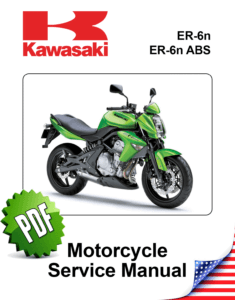
Kawasaki ER-6n / ER-6n ABS Service Manual (2012)
Kawasaki ER-6n and ER-6n ABS factory service manual for 2012 ER650E/F models. This 629-page searchable PDF covers periodic maintenance, DFI diagnostics, the 649 cc parallel-twin engine, clutch, transmission, chain drive, ABS, suspension and electrical systems.
Get the Kawasaki ER-5 2nd Generation (ER500C/D) Service Manual
Click the Buy Now button below to get the complete PDF manual.