
Kawasaki KX125 / KX250 Service Manual (2003-2008)
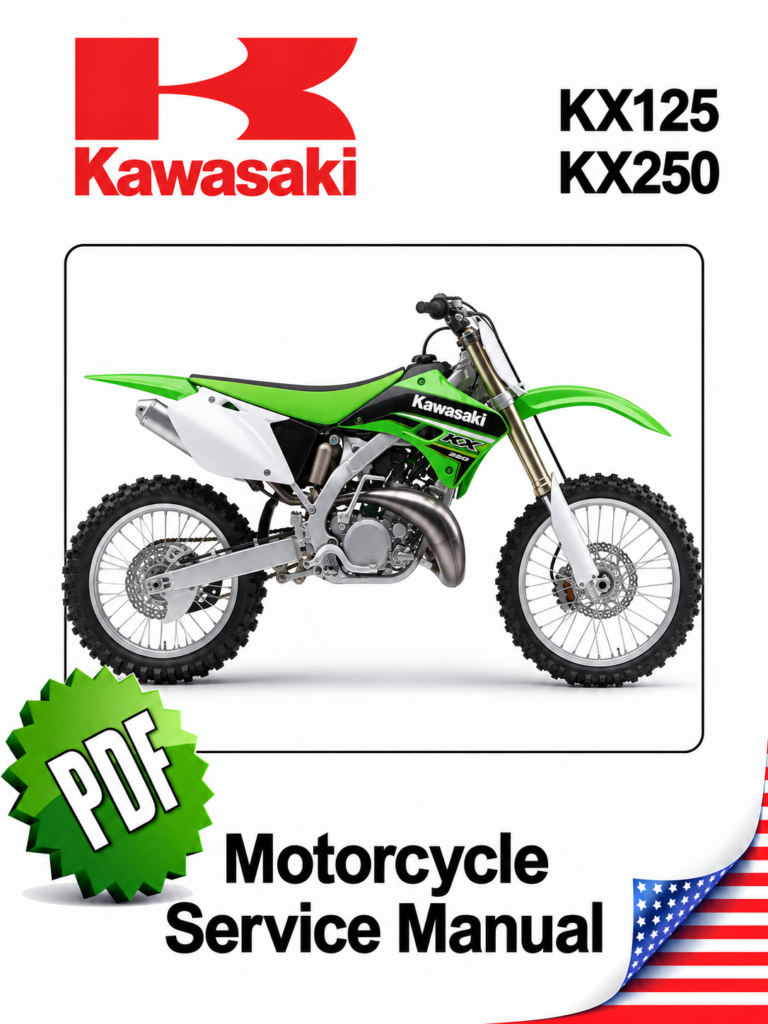

Kawasaki factory KX125 / KX250 Motorcycle Service Manual, publication 99924-1298-07, ©2002 Kawasaki Heavy Industries Ltd., seventh edition (1) dated March 22, 2007, printed in Japan. The 348-page printable English PDF is mostly text-searchable (337 pages have extractable text, 11 are image-only/blank) and explicitly identifies KX125-M1 (2003), M2 (2004), M3 (2005), M6F (2006), M7F (2007), M8F (2008), plus KX250-M1 (2003) and M2 (2004) in its factory model-application table on PDF page 348. It does NOT cover KX250 model-specific 2005–2008 changes; those belong to a later generation and separate factory publication. The source specifies liquid-cooled 124 cc KX125 crankcase-reed and 249 cc KX250 piston-reed two-stroke singles, Mikuni TMX38 and Keihin PWK38S carburetors respectively, fuel/oil premix 32:1, CDI ignition and kickstarting, KIPS exhaust power valves, a wet multi-plate manual clutch, KX125 six-speed or KX250 five-speed gearboxes, chain final drive and Uni-Trak rear suspension. Repair subjects include Kawasaki racing service intervals, model-specific torque and specifications, carburetor fuel level/jetting and reed-valve inspections, radiators and water pumps, cylinder heads and plated cylinder/piston fitment, KIPS valve and governor overhaul, clutch/primary gear/kickstarter service, engine removal, crankcase/crankshaft and transmission overhaul, wheels/tires, sprockets, disc brakes, fork/shock service, steering, CDI/magneto and electrical faultfinding with wiring diagrams, cable/wire/hose routing and factory troubleshooting.
About the Manual
- Manual type
- Factory Service Manual
- Years covered*
- 2003–2008
- Pages
- 348
- Language
- English
- Format
- Main sections
- 29
- Searchable PDF
- Yes
- Printable PDF
- Yes
- File size
- 4.3 MB
- Delivery
- Digital download
* Indicative only. Please do your own research and confirm compatibility with your exact motorcycle and model year before purchasing.
Kawasaki M-series two-strokes: 125 cc M1–M3/M6F–M8F (2003–2008); 250 cc M1–M2 (2003–2004) Motorcycle Details
What’s Included in the Kawasaki M-series two-strokes: 125 cc M1–M3/M6F–M8F (2003–2008); 250 cc M1–M2 (2003–2004) Service Manual?
- Factory model identification, Kawasaki publication data and chassis specifications
- Application table: KX125 2003–2008 / KX250 2003–2004
- General service precautions, torque tightening sequences and special tools
- Engine and chassis specifications with model-specific compression ratios
- Periodic racing maintenance chart: 2.5-, 7.5-, 12.5- and 25-hour service
- Premix fuel/oil 32:1 and transmission oil maintenance
- Carburetor service: KX125 Mikuni TMX38 and KX250 Keihin PWK38S
- Float-height and fuel-level measurement, jets, needles and throttle cables
- Carburetor sensor/fuel cut-off controls on KX250
- Reed-valve inspection, fuel tank, fuel tap and foam air filter
- Radiator, coolant draining/refilling, water-pump seals and impeller
- Compression test, cylinder heads, cylinder coatings and wear limits
- KX125 and KX250 piston, piston rings, pins, cylinder bores and gaskets
- Kawasaki Integrated Power-valve System (KIPS) exhaust-valve and governor rebuilds
- Exhaust expansion chambers, silencers and muffler packing
- Wet clutch friction plates, cable adjustment and clutch hub inspection
- Clutch cover, primary drive gears and external shift mechanism
- Kickstarter, ratchet, kickshaft and return spring
- Complete engine removal, engine-mounting torque and engine installation
- Crankcase splitting, crankshaft and connecting rod servicing
- KX125 six-speed and KX250 five-speed transmission overhaul
- Front/rear wheels, tyres, spoke tension and wheel bearings
- Drive chain wear, alignment, sprocket service and chain tension
- Front and rear hydraulic disc brakes, master cylinders, pads and bleeding
- Front inverted fork disassembly, oil level and damping adjustments
- Rear Uni-Trak shock and linkage overhaul, pivots and swingarm
- Steering stem bearings, steering adjustments, handlebars and frame checks
- CDI ignition, flywheel/magneto, spark plugs and electrical troubleshooting
- Electrical wiring diagrams, cable routing, troubleshooting and appendix tables
Preview Inside the Manual
See a selection of pages from this service manual before purchasing.
Click a sample page to enlarge it. Preview images are excerpts only; the complete manual is supplied after purchase.
Get the Complete Kawasaki M-series two-strokes: 125 cc M1–M3/M6F–M8F (2003–2008); 250 cc M1–M2 (2003–2004) Service Manual
348 pages • PDF • Instant download
About the Kawasaki KX125 and KX250
Kawasaki developed its KX motocross family around lightweight competition chassis and powerful two-stroke engines, providing separate 125 cc and 250 cc machines for their respective racing classes. By the late 1990s, both motorcycles had adopted liquid cooling, reed-valve induction, the Kawasaki Integrated Power-valve System (KIPS), and steel perimeter-style frames. The 125 cc category emphasized momentum and close-ratio shifting, whereas the 250 cc category demanded broader torque and strong acceleration between corners. Riders chose between the smaller machine's six-speed gearbox and the larger machine's five-speed unit, but each relied on a responsive carbureted single-cylinder engine. As four-strokes began challenging traditional motocross classes, Kawasaki undertook a major overhaul of both two-stroke models to remain competitive during the early 2000s.
For the 2003 model year, Kawasaki substantially redesigned the KX125 KX250 range. Both M1-generation motorcycles received newly designed steel perimeter frames, refreshed bodywork and suspension geometry intended to improve cornering precision without sacrificing stability. Kawasaki's June 2002 factory announcement of the 2003 KX models detailed these developments, including a revised five-speed KX250 shift mechanism and a six-speed KX125 arrangement. The smaller KX125-M1 adopted a redesigned 124 cc engine with a 54.0 mm bore and 54.5 mm stroke and a 38 mm Mikuni TMX carburetor. The KX250-M1 used a 249 cc engine with a 66.4 mm bore and 72.0 mm stroke, a Keihin PWK38S carburetor and five-speed transmission. Both engines featured improved cylinder coatings and revised KIPS exhaust-valve operation.
The 2004 KX125-M2 and KX250-M2 continued the M-series developments but incorporated distinct engine and chassis refinements. In the KX250, Kawasaki revised port timing, cylinder compression, induction and exhaust components in pursuit of improved response across the rev range. The 2004 KX250 was not simply a cosmetic continuation of the 2003 motorcycle; its tuning changes sought stronger output and smoother power delivery in different track conditions. MotorcycleDaily's contemporary 2004 review records these changes. The KX125 also gained revised compression specifications and changes to its frame geometry, ergonomics and rear-suspension linkage. Through 2004, both models retained carburetors, kickstarters, hand-operated wet clutches, hydraulic disc brakes and the typical competition-oriented maintenance demands of high-output two-strokes.
The two product lines followed different documentation and development paths after 2004. The KX250 received a substantial 2005 revision, featuring a different KIPS operating strategy, revised cooling passages, changed steering geometry and twin-chamber Kayaba forks. Kawasaki therefore did not treat the later 2005–2008 KX250 models as the same M1/M2 series documented for 2003–2004. By contrast, the KX125 continued through the M3 in 2005, M6F in 2006, M7F in 2007 and M8F in 2008 in the markets reflected in Kawasaki's model identification records. Refinements across those KX125 versions included changes to riding position, controls, ignition specifications and chassis parts. A contemporary 2005 Kawasaki model report records the adjustments to both motorcycles, while highlighting the greater scope of the KX250 redesign.
The early-2000s two-stroke motocross generation also developed alongside a major shift toward four-stroke racing motorcycles. In August 2003 Kawasaki announced the new 250 cc four-stroke KX250F, which joined rather than replaced the established two-stroke KX250 identity. Those motorcycles are mechanically different despite sharing the KX and 250 designations: the carbureted two-stroke KX250 used different engine internals, maintenance procedures and gearing from the four-stroke KX250F. Kawasaki's original KX250F announcement documents that transition. The KX125's continued development through its 2008 M8F designation illustrates the survival of the smaller two-stroke motocross platform in selected markets. The distinction between 2003–2008 KX125 and 2003–2004 KX250 variants is essential to the history of these machines. Related titles appear in the Kawasaki service manual catalog.
Why Choose a Digital PDF Service Manual?
We supply service manuals as digital PDF downloads rather than printed books.
We do not offer printed manuals. Digital delivery has several practical advantages:
- Digital delivery avoids producing and shipping an additional printed copy.
- Keep your master copy clean and grease-free while you work on your motorcycle.
- Print only the specific page or pages you need for the job.
- Access the manual immediately after successful payment.
- Search the PDF to find terms, procedures and components quickly.
Related Kawasaki Service Manuals
Kawasaki 1400GTR / Concours 14 / Concours 14 ABS Service Manual (2008)
Kawasaki 1400GTR, Concours 14 and Concours 14 ABS factory service manual for 2008 ZG1400A8F/ZG1400B8F models. This 803-page searchable PDF covers maintenance, DFI, variable valve timing, KIPASS, hydraulic clutch, 6-speed transmission, Tetra Lever shaft drive, brakes, suspension and electrical systems.

Kawasaki Bajaj Pulsar 200 NS / Rouser 200 NS Service Manual (2013–2014)
Kawasaki-Bajaj Pulsar 200 NS and Rouser 200 NS factory service manual for 2013 BR200AD and 2014 BR200AE models. This 411-page searchable PDF covers maintenance, carburetor fuel system, liquid-cooled 200 cc engine, clutch, 6-speed transmission, chain drive, brakes, suspension and electrical systems.

Kawasaki EN500 / Vulcan 500 LTD Service Manual (1996–2008)
Kawasaki EN500 / Vulcan 500 LTD factory service manual for 1996–2008 C-series models. This 351-page searchable PDF covers maintenance, twin Keihin carburetors, the 498 cc DOHC engine, 6-speed transmission, chain drive, brakes, suspension and electrical systems.

Kawasaki ER-5 Service Manual (2001–2005)
Kawasaki ER-5 factory service manual for 2001–2005 ER500C/D models. This 334-page searchable PDF covers the 498 cc parallel-twin engine, Keihin carburetors, six-speed transmission, chain drive, chassis, brakes and electrical systems.
Get the Kawasaki M-series two-strokes: 125 cc M1–M3/M6F–M8F (2003–2008); 250 cc M1–M2 (2003–2004) Service Manual
Click the Buy Now button below to get the complete PDF manual.