
Moto Guzzi Daytona 1000 Service Manual (1992-1995)
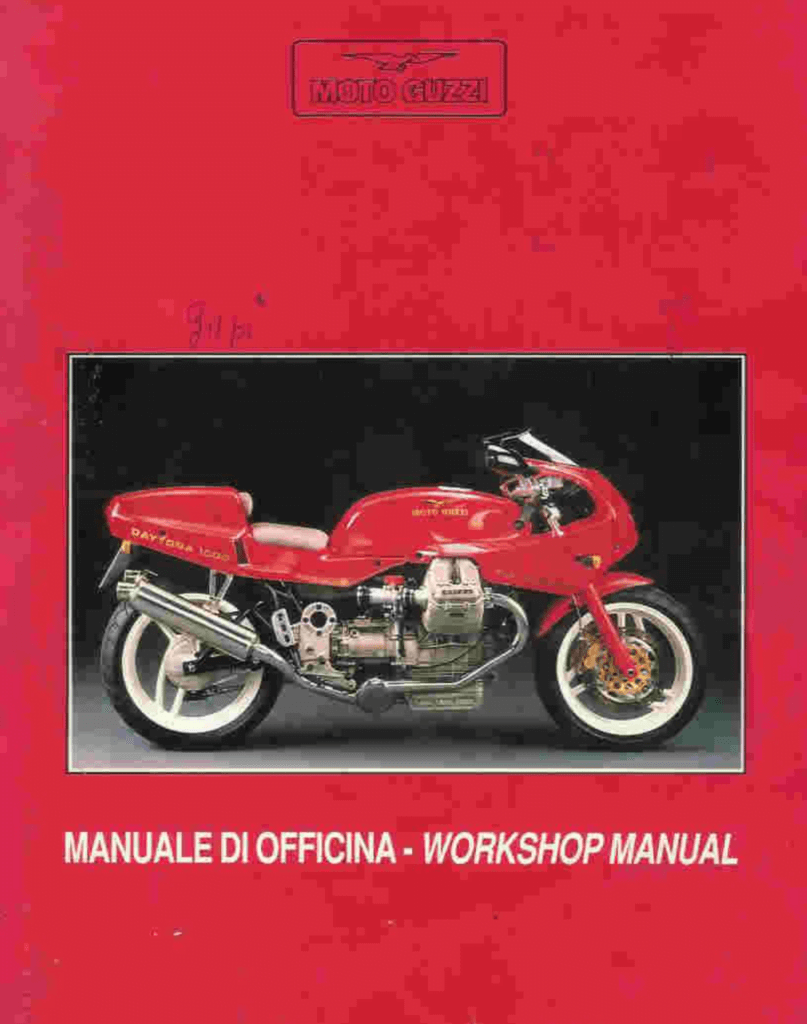

Original Moto Guzzi factory Workshop Manual / Manuale d'Officina, Technical Publications code 30 92 01 00, printed 02/93, for the Daytona 1000. The 148-page bilingual scanned PDF covers general specifications, scheduled maintenance, special tools, torque settings, engine dismantling and reassembly, cam timing and checks, Weber-Marelli injection and ignition, dry twin-disc clutch, five-speed gearbox, rear drive, frame, Marzocchi front fork, rear suspension, wheels, brake system and electrical system.
About the Manual
- Manual type
- Factory Service Manual
- Years covered*
- 1992–1995
- Pages
- 148
- Language
- Italian / English
- Format
- Main sections
- 15
- Searchable PDF
- No
- Printable PDF
- Yes
- File size
- 23.3 MB
- Delivery
- Digital download
* Indicative only. Please do your own research and confirm compatibility with your exact motorcycle and model year before purchasing.
Moto Guzzi Daytona 1000 Daytona 1000; original 1992-1995 four-valve production generation Motorcycle Details
What’s Included in the Moto Guzzi Daytona 1000 Daytona 1000; original 1992-1995 four-valve production generation Service Manual?
- General Features
- Service Schedule
- Specific Equipment
- Torque Wrench Settings
- Engine Unit
- Injection - Ignition
- Clutch
- Gearbox
- Rear Drive
- Frame
- Front Fork
- Rear Suspension
- Wheel
- Brake System
- Electrical System
Preview Inside the Manual
See a selection of pages from this service manual before purchasing.
Click a sample page to enlarge it. Preview images are excerpts only; the complete manual is supplied after purchase.
Get the Complete Moto Guzzi Daytona 1000 Daytona 1000; original 1992-1995 four-valve production generation Service Manual
148 pages • PDF • Instant download
About the Moto Guzzi Daytona 1000
Moto Guzzi launched the Daytona 1000 in 1992 as one of the most technically ambitious road motorcycles produced at Mandello del Lario during the De Tomaso era. Its roots reached back into Moto Guzzi’s renewed American racing activity in the 1980s and the work of Dr. John Wittner, whose endurance-racing Guzzis helped demonstrate that the traditional transverse V-twin could support a much more modern performance chassis. Moto Guzzi’s official company history lists the Daytona 1000 IE as a key 1992 launch, while Piaggio Group’s retrospective material places the Daytona among the marque’s defining sporting motorcycles of the period.
The production Daytona transformed that racing influence into a distinctive road-going package. Its 992 cc 90-degree V-twin used a 90 × 78 mm bore and stroke, 10:1 compression and, unusually for a Moto Guzzi of the time, four valves per cylinder with overhead camshafts. Factory specification was 70 kW, or 95 CV, at 8,000 rpm and 98 Nm at 6,000 rpm. Weber-Marelli sequential electronic injection and digital ignition gave the Daytona a much more advanced fuel and ignition system than the carburetted Le Mans models that had defined Moto Guzzi performance through the previous decade.
The motorcycle was equally distinctive beneath its bodywork. A rectangular-section NiCrMo steel spine frame carried an adjustable Marzocchi fork and a Koni rear monoshock, while shaft final drive remained a core part of the Moto Guzzi identity. Twin 300 mm floating front discs, a 260 mm rear disc, 17-inch front and 18-inch rear cast wheels and a 1,480 mm wheelbase reflected its early-1990s sporting intent. At 215 kg dry with a 23-litre tank, the Daytona was a substantial machine, but its purpose was clear: it was a four-valve Italian shaft-drive superbike built to move Moto Guzzi beyond the architecture and image of the earlier Le Mans generation.
The Daytona’s development path is closely tied to Dr. John Wittner’s racing programme. Contemporary testing by Cycle World in 1992 traced the four-valve engine back to Umberto Todero’s mid-1980s work and to Wittner’s steel-backbone race chassis, which achieved a notable Daytona Pro-Twins result before the road bike appeared. The production model then evolved into the Daytona Racing 1000 for 1996 and the Daytona RS for 1997-1998. Those later motorcycles shared the Daytona name but are separately identified in Moto Guzzi parts catalogues and should not be treated as the same service generation as the original 1992-1995 machine.
This product covers the original 1992-1995 Daytona 1000 generation documented by factory Workshop Manual 30 92 01 00. It does not automatically cover the separate 1996 Daytona Racing or 1997-1998 Daytona RS variants. Related workshop documentation is grouped in the Moto Guzzi Daytona 1000 service manual catalog.
Why Choose a Digital PDF Service Manual?
We supply service manuals as digital PDF downloads rather than printed books.
We do not offer printed manuals. Digital delivery has several practical advantages:
- Digital delivery avoids producing and shipping an additional printed copy.
- Keep your master copy clean and grease-free while you work on your motorcycle.
- Print only the specific page or pages you need for the job.
- Access the manual immediately after successful payment.
Related Moto Guzzi Service Manuals

Moto Guzzi 1200 Sport 2V ABS Service Manual (2007-2008)
Moto Guzzi 1200 Sport 2V ABS 2007-2008 original factory service station manual PDF download. Covers the 1151 cc V-twin, scheduled maintenance, full engine overhaul, EFI diagnostics, ABS, six-speed transmission, shaft drive, suspension, chassis and bodywork.

Moto Guzzi 1200 Sport 4V ABS Service Manual (2009)
Moto Guzzi 1200 Sport 4V ABS 2009 original factory service station manual PDF download. Covers the 1151 cc V-twin, scheduled maintenance, full engine overhaul, EFI diagnostics, ABS, six-speed transmission, shaft drive, suspension, chassis and bodywork.
Moto Guzzi Audace Service Manual (2015)
Moto Guzzi Audace 2015 original factory service station manual PDF download. Covers the 1379.6 cc V-twin, scheduled maintenance, electrical diagnostics, engine and gearbox overhaul, ride-by-wire EFI, shaft drive, suspension, ABS brakes and bodywork.
Moto Guzzi Bellagio 940 Service Manual (2007-2014)
Moto Guzzi Bellagio 940 2007-2014 original factory service station manual PDF download. Covers the 935.6 cc V-twin, maintenance, electrical diagnostics, complete engine service, Magneti Marelli EFI, six-speed gearbox, reactive shaft drive, suspension, brakes and bodywork.
Get the Moto Guzzi Daytona 1000 Daytona 1000; original 1992-1995 four-valve production generation Service Manual
Click the Buy Now button below to get the complete PDF manual.