
Yamaha YZF-R1 Racing Kit Manual (2024)
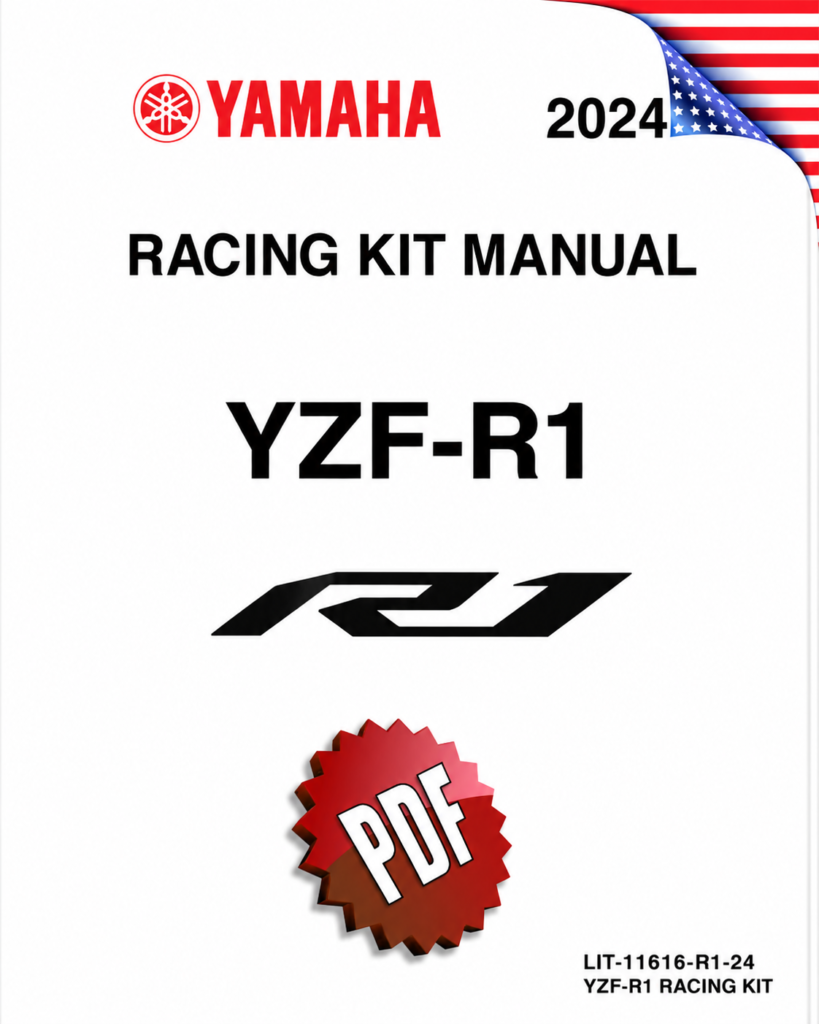

Original Yamaha Motor Engineering January 2024 English YZF-R1 GYTR Racing Kit Manual, exactly 106 printable pages and searchable (105 pages with embedded text, the image-only cover is the only non-text page). This is a racing kit parts catalog and workshop installation/setup guide for SBK/JSB, SST and standard YZF-R1 platforms, not a conventional complete factory service manual. Its engine comparison lists 998 cc, 79 × 50.9 mm and compression targets of 13.0:1 for STD/SST or 13.0–13.4:1 SBK/JSB. It gives kit ECU B3L-8591A-72 / B3L-8591A-A1, base-map programming and Yamaha matching software, electrical cable interfaces, racing sub-harnesses, race camshafts and springs, pistons, crankshaft/connecting rod kits, air funnels, clutch/spacer components, alternate race transmission gear sets, 520 drive sprocket options, shocks and forks, seat pads, brake caliper parts, tightening torque tables, wiring/connector diagrams and race-only setup cautions. The manual directs readers to the separate YZF-R1 Service Manual for standard motorcycle maintenance and assembly; supplied kit components are for competition rather than public road use.
About the Manual
- Manual type
- Racing Kit Manual
- Years covered*
- 2024
- Pages
- 106
- Language
- English
- Format
- Main sections
- 33
- Searchable PDF
- Yes
- Printable PDF
- Yes
- File size
- 4.2 MB
- Delivery
- Digital download
* Indicative only. Please do your own research and confirm compatibility with your exact motorcycle and model year before purchasing.
Yamaha YZF-R1 2024 GYTR competition kit; SBK/JSB and SST specifications Motorcycle Details
What’s Included in the Yamaha YZF-R1 2024 GYTR competition kit; SBK/JSB and SST specifications Service Manual?
- 2024 YZF-R1 GYTR Kit Manual cover and racing-use introduction
- Factory comparison of SBK/JSB, SST and standard R1 engine specifications
- Race engine-speed limits, compression targets, valve timing and squish values
- Race ECU sets B3L-8591A-72 and B3L-8591A-A1
- Yamaha kit cable interface and electronic setup connection
- Race wire-harness set and associated connectors
- Sub-lead wiring harnesses and control-system wiring
- Headlight harness and racing electrical repair sets
- CCU communication/control unit kit and setup notes
- Engine maintenance parts and approved racing component combinations
- Racing spark-plug set, cylinder-head and cylinder gaskets
- Racing piston set and associated installation precautions
- Connecting-rod set and crankshaft parts
- SBK high-lift intake and exhaust camshaft installation
- SBK cam sprocket and SST cam sprocket assembly
- Race valve spring set and approved camshaft/ECU combinations
- Racing intake air-funnel kit and assembly
- AIS plug kit and racing exhaust gasket options
- Clutch spring spacer and clutch boss assembly
- Racing transmission gear options and gearset precautions
- Race gearbox maintenance service parts
- Front drive sprockets, retaining nuts and rear sprocket options
- Engine oil strainer cover kit and installation
- Optional racing strainer assemblies including SST type
- Event-angle measuring tool kit
- Rear shock and front-fork spring choices
- Racing seat cushion, seat pad and spare wheel assemblies
- Front brake caliper piston set and tube guide
- Factory race-build tightening-torque specifications
- Cylinder-head and crankcase assembly tightening sequence and bolt-angle guidance
- Engine installation and pivot-shaft surrounding parts
- Headlight cable wiring diagram
- YZF-R1 race wiring diagrams and connector identification
Preview Inside the Manual
See a selection of pages from this service manual before purchasing.
Click a sample page to enlarge it. Preview images are excerpts only; the complete manual is supplied after purchase.
Get the Complete Yamaha YZF-R1 2024 GYTR competition kit; SBK/JSB and SST specifications Service Manual
106 pages • PDF • Instant download
About the Yamaha YZF-R1
Yamaha introduced the original YZF-R1 in 1998, creating a compact 998 cc four-cylinder supersport motorcycle intended to combine large-engine acceleration with the agility of a smaller machine. Its engine layout included a vertically stacked transmission that shortened the powertrain, helping Yamaha concentrate the motorcycle's mass and achieve a short wheelbase. The first model produced a claimed 150 PS with a 177 kg dry weight, setting an influential benchmark for Japanese litre-class sportbikes. Its aluminium Deltabox frame, distinctive twin-headlamp fairing and closely packaged inline-four established the appearance and engineering philosophy of the R1 family. Yamaha's 25-year model retrospective describes the original machine and the major developments that followed.
During the early 2000s the R1 evolved through successive generations with more sophisticated engine-management systems and chassis designs. The 2002 revision adopted fuel injection while preserving the model's emphasis on compact dimensions and rapid engine response. The 2004 redesign introduced a new 998 cc engine and modernized its frame, styling and under-seat exhaust arrangement. For 2007 Yamaha revised the high-revving engine, adopting a four-valve-per-cylinder head and Yamaha Chip Controlled Intake alongside electronically controlled throttles. Rather than maintaining one static design, the R1 developed through repeated attempts to improve throttle response, acceleration and stability under racetrack conditions. These changes also prepared the way for an even more significant transformation of its engine character at the end of the decade.
For 2009, Yamaha introduced the distinctive crossplane-crankshaft superbike configuration. The new uneven-firing-order inline-four engine used principles developed from the YZR-M1 MotoGP programme to improve the rider's sense of rear-tyre traction when exiting corners. Its engine, frame and ergonomics were redesigned together rather than modified in isolation. This crossplane architecture became a central part of the R1's identity, differentiating its power delivery and exhaust note from conventional inline-four sportbikes. Yamaha's official announcement of the 2009 redesign explains the technical thinking behind the crossplane crankshaft and its connection to corner-exit control.
The 2015 generation shifted the motorcycle still further toward dedicated circuit performance. Yamaha introduced a 998 cc crossplane engine with titanium connecting rods, a sophisticated six-axis inertial measurement unit and a comprehensive range of electronic rider aids. The more specialized R1M variant added electronically controlled Öhlins suspension and other premium track-oriented components, while the standard R1 retained its own suspension configuration. Lightweight chassis components and integrated software controls helped manage acceleration, braking and cornering. Yamaha's 2015 R1 heritage profile highlights the model's MotoGP-inspired engineering and its progression toward a pure supersport motorcycle, rather than the broader road-biased role of the original 1998 machine.
The R1 received a substantial technical refresh for 2020, with revised bodywork and aerodynamics, updated intake and valve-train details, an improved electronic throttle interface and expanded braking-related control functions. The 2024 YZF-R1 continued the mature 998 cc crossplane platform, with a six-speed transmission, electronically managed fuel injection and advanced inertial-sensor-based controls. The standard model used adjustable KYB suspension, while the contemporary R1M retained its Öhlins electronic suspension identity. Competition teams and track riders continued to develop race-specific parts around the base engine and chassis in several racing categories. This ongoing relationship between the production R1 and competitive racing reflects Yamaha's long-standing development philosophy. For additional editions and related motorcycles, see the Yamaha manuals catalog.
Why Choose a Digital PDF Service Manual?
We supply service manuals as digital PDF downloads rather than printed books.
We do not offer printed manuals. Digital delivery has several practical advantages:
- Digital delivery avoids producing and shipping an additional printed copy.
- Keep your master copy clean and grease-free while you work on your motorcycle.
- Print only the specific page or pages you need for the job.
- Access the manual immediately after successful payment.
- Search the PDF to find terms, procedures and components quickly.
Related Yamaha Service Manuals
Yamaha BT1100 Bulldog Service Manual (2002)
Yamaha BT1100 Bulldog factory service manual for the 2002 5JN1 model. This 356-page searchable and printable PDF covers general information, specifications, periodic maintenance, complete engine service, carburetion, chassis, electrical systems, troubleshooting and the factory wiring diagram.
Yamaha FZ1-N / FZ1-NA / FZ1-S / FZ1-SA Fazer Service Manual (2008)
Yamaha factory service manual for the 2008 FZ1-N, FZ1-NA, FZ1-S and FZ1-SA Fazer. This 546-page searchable and printable PDF covers specifications, periodic maintenance, chassis, engine overhaul, cooling, electronic fuel injection, ABS, electrical diagnostics, troubleshooting and factory wiring diagrams.
Yamaha FZ1-N / FZ1-S Fazer Service Manual (2006)
Yamaha factory service manual for the 2006 FZ1-N and FZ1-S Fazer. This 451-page searchable and printable PDF covers specifications, periodic maintenance, chassis, engine overhaul, cooling, electronic fuel injection, electrical diagnostics, troubleshooting and factory wiring diagrams.
Yamaha FZ6 / Fazer Service Manual (2007)
Yamaha factory service manual for the 2007 FZ6-N, FZ6-NA, FZ6-S, FZ6-SA and high-grade FZ6 variants. This 538-page searchable and printable PDF covers specifications, periodic maintenance, chassis, ABS, engine overhaul, cooling, fuel injection, electrical diagnostics, troubleshooting and factory wiring diagrams.
Get the Yamaha YZF-R1 2024 GYTR competition kit; SBK/JSB and SST specifications Service Manual
Click the Buy Now button below to get the complete PDF manual.