
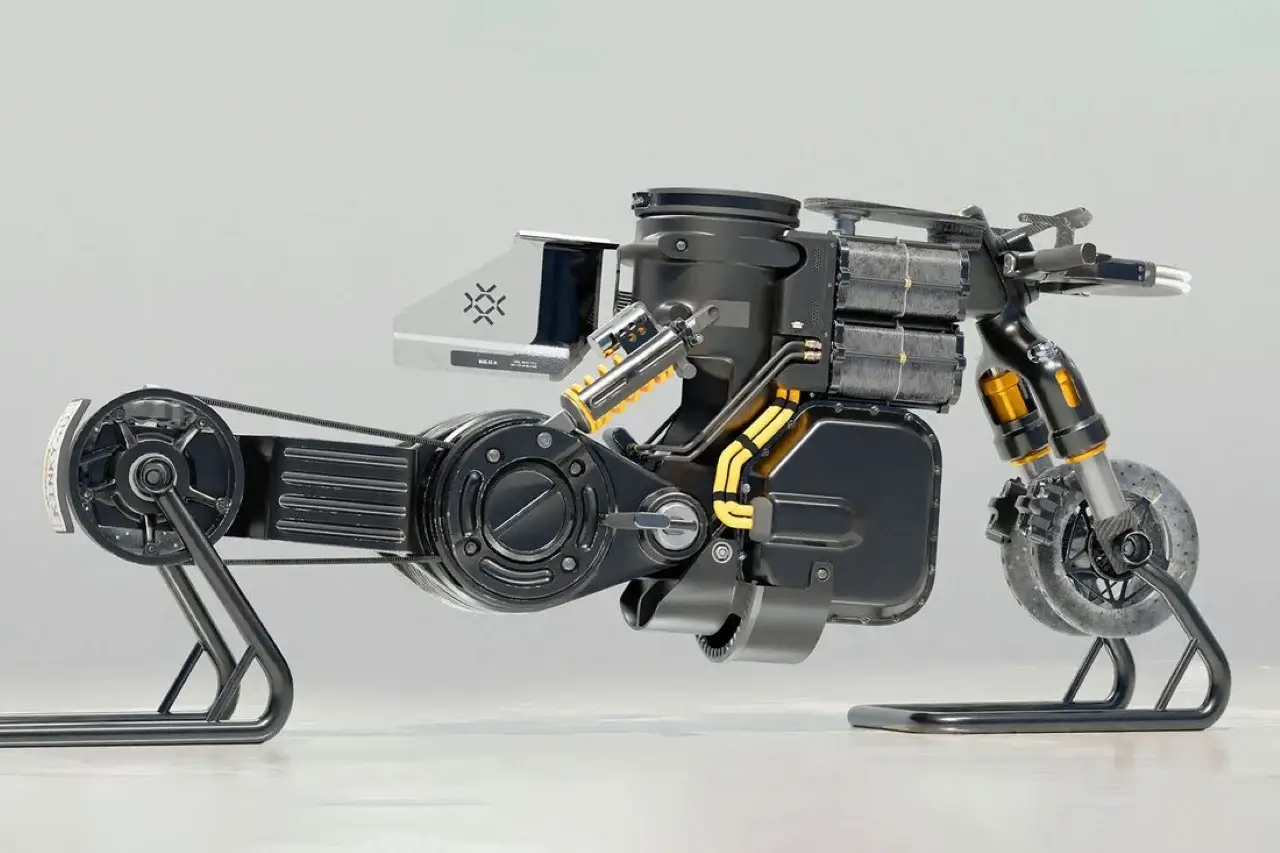
Hydrogen-powered motorcycles are no longer a single technological idea.
Two very different approaches are now being developed. A hydrogen fuel-cell motorcycle uses hydrogen to generate electricity for an electric motor. A hydrogen internal-combustion motorcycle burns hydrogen inside an engine much like a gasoline motorcycle burns petrol.
That distinction has become increasingly important.
Suzuki spent years developing fuel-cell versions of the Burgman scooter. More recently, Kawasaki demonstrated a hydrogen-burning motorcycle based on the supercharged Ninja H2 engine, while Kawasaki, Honda, Suzuki and Yamaha have joined forces through the HySE research association to study hydrogen combustion for motorcycles and other small vehicles.
Hydrogen motorcycles therefore sit somewhere between two familiar worlds: the electric motorcycle and the conventional combustion-engine bike.
Their future will depend not only on whether the motorcycles work, but also on hydrogen storage, refueling infrastructure, emissions, fuel production, cost and whether enough hydrogen can be carried on something as compact as a motorcycle.
“Hydrogen motorcycle” can mean two very different machines
The easiest way to understand hydrogen motorcycles is to separate the fuel from the powertrain.
Hydrogen is an energy carrier. What the motorcycle does with that hydrogen determines how it works.
Fuel-cell hydrogen motorcycles
A fuel-cell motorcycle stores compressed hydrogen and feeds it into a fuel-cell stack.
Inside the stack, hydrogen reacts electrochemically with oxygen from the surrounding air. That process generates electricity.
The electricity then powers an electric motor.
The basic energy path is:
hydrogen tank → fuel cell → electricity → electric motor → rear wheel
A battery is commonly incorporated into the system as well. It can buffer power demand, store regenerated energy and assist the fuel cell when additional output is required.
The motorcycle therefore behaves mechanically much more like an electric motorcycle than a gasoline motorcycle.
There are no conventional combustion cycles occurring inside the fuel cell.
At the point of use, a hydrogen fuel cell produces water rather than conventional combustion exhaust gases. The U.S. Department of Energy notes that fuel cells generate electricity electrochemically and do not create the harmful direct emissions associated with high-temperature combustion.
Hydrogen internal-combustion motorcycles
A hydrogen combustion motorcycle takes a different route.
Instead of converting hydrogen into electricity, it feeds hydrogen into an internal-combustion engine and burns it.
The basic path is:
hydrogen tank → fuel system → engine → transmission → final drive → rear wheel
Mechanically, this approach can preserve much of what riders associate with a conventional motorcycle:
- pistons
- crankshaft
- valves
- transmission
- clutch
- exhaust
- engine sound
- vibration and mechanical character
That is why manufacturers such as Kawasaki and Suzuki are interested in the technology.
Hydrogen combustion potentially offers a path toward reducing carbon emissions while retaining an engine-based riding experience.
But it also inherits many of the technical challenges of combustion engines and adds the considerable challenge of storing hydrogen on a motorcycle.
Suzuki proved that a fuel-cell motorcycle could work on public roads
Fuel-cell motorcycles are not a recent invention.
Suzuki showed the Crosscage hydrogen fuel-cell concept in 2007 and subsequently developed the technology into the more practical Burgman Fuel Cell Scooter.
The Burgman used a compressed-hydrogen tank, an air-cooled polymer-electrolyte fuel cell, a lithium-ion battery and an electric motor.
Suzuki reported a test range of approximately 350 km under specific low-speed test conditions, using hydrogen stored at 70 MPa. In 2011, the Burgman became the first fuel-cell vehicle of its type to obtain European Whole Vehicle Type Approval.
Development continued.
Suzuki later obtained Japanese type certification for the Burgman Fuel Cell and began public-road testing in Japan in 2017. The company used those tests to evaluate the practicality and marketability of fuel-cell motorcycles.
The project demonstrated that a hydrogen fuel-cell two-wheeler was technically possible.
It did not, however, lead to mass adoption.
Hydrogen storage, cost and refueling availability remained difficult problems.
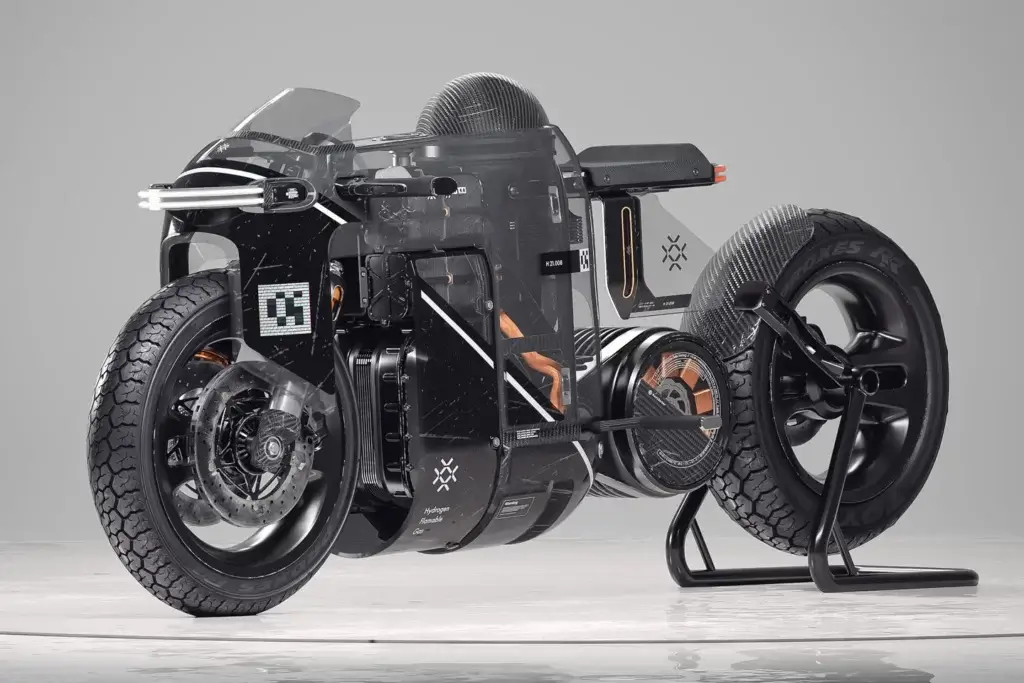
ydrogen can power a motorcycle either through a fuel cell and electric motor or through a hydrogen-burning internal-combustion engine.Kawasaki changed the conversation with a hydrogen-burning Ninja H2
The modern hydrogen-motorcycle discussion shifted substantially when Kawasaki moved away from the fuel-cell approach and began developing a hydrogen-burning engine.
Kawasaki based its research motorcycle on the 998 cc supercharged inline-four engine from the Ninja H2.
The engine was modified to use direct hydrogen injection, while the motorcycle’s chassis had to be redesigned to accommodate hydrogen cylinders and the associated fuel-supply hardware.
In July 2024, Kawasaki conducted what it described as the world’s first public demonstration run of a hydrogen internal-combustion motorcycle by a mass-production motorcycle manufacturer at Suzuka Circuit in Japan.
This matters because the motorcycle did not use hydrogen to generate electricity.
It actually burned hydrogen in an engine.
Kawasaki’s project is therefore much closer mechanically to a conventional petrol-powered motorcycle than to a battery-electric or fuel-cell bike.
The company continued demonstrating the hydrogen motorcycle in 2025, including a parade run in Paris during the final stage of the Tour de France. Kawasaki has described hydrogen combustion as one of several technologies it is studying for carbon-neutral mobility and has discussed the early 2030s as a potential timeframe for practical hydrogen-engine motorcycles, depending on infrastructure and fuel availability.
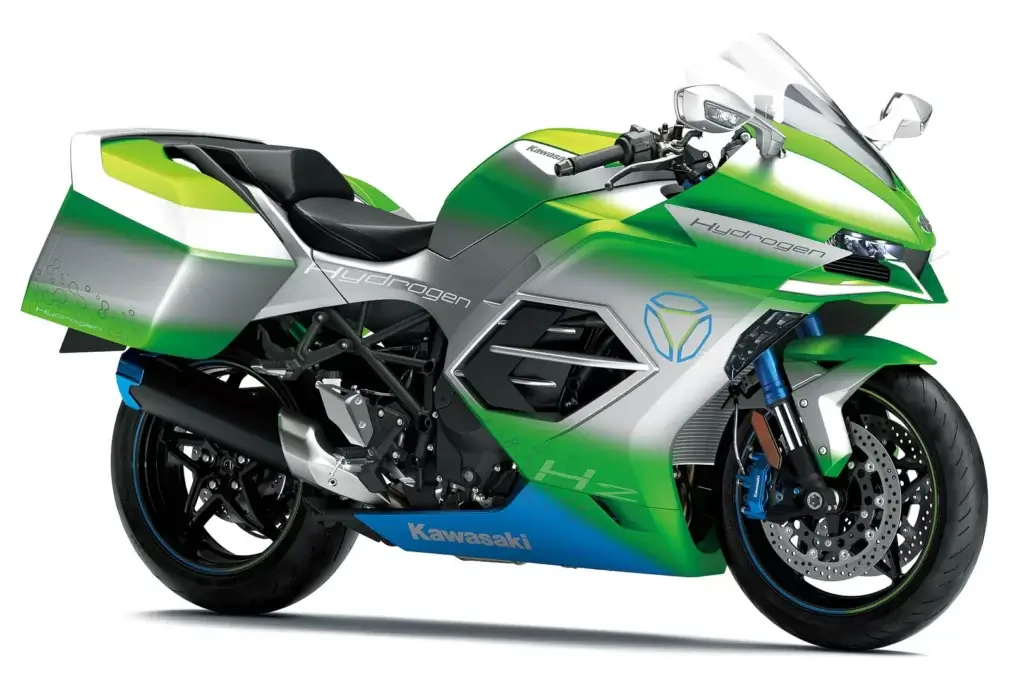
Kawasaki is developing a hydrogen-burning motorcycle around technology derived from the supercharged Ninja H2 engine. Its research bike uses direct hydrogen injection rather than a fuel-cell electric drivetrain.Kawasaki, Honda, Suzuki and Yamaha are researching hydrogen together
Hydrogen combustion is not only a Kawasaki project.
In 2023, Kawasaki Motors, Suzuki, Honda and Yamaha Motor established the Hydrogen Small mobility & Engine technology research association, known as HySE.
Toyota and Kawasaki Heavy Industries also participate in supporting roles.
The group is studying several problems specific to hydrogen engines for small vehicles, including:
- hydrogen combustion
- fuel-injection systems
- hydrogen tanks
- fuel-supply components
- refueling
- technical standards
- regulatory requirements
HySE specifically identifies two difficult characteristics of hydrogen: its fast flame speed and broad ignition range. Both complicate stable combustion. The group also identifies limited tank capacity as a major problem when hydrogen is used in small vehicles.
This collaborative effort is important because motorcycle manufacturers rarely share fundamental engine research at this scale.
It also suggests that hydrogen is being investigated as a possible additional powertrain option, rather than as a simple replacement for every gasoline motorcycle.
Hydrogen engines are already being tested far beyond a laboratory
HySE has also used motorsport-style testing to expose hydrogen powertrains to demanding real-world conditions.
Its HySE-X2 research vehicle entered the Mission 1000 category of the 2025 Dakar Rally.
The vehicle used a supercharged 998 cc four-cylinder hydrogen engine and carried four 70 MPa hydrogen tanks with a total hydrogen capacity of 7.2 kg.
HySE reported that the X2 completed all stages of the event and finished second in its class. The project was used to investigate performance, fuel consumption, hydrogen storage and other technical issues under severe operating conditions.
The HySE-X2 is not itself a conventional two-wheel motorcycle, but its engine research is directly relevant to the development of hydrogen powertrains for motorcycles and other compact mobility applications.
Suzuki has also moved from fuel cells toward hydrogen combustion
Suzuki’s hydrogen history is particularly interesting because the company has explored both major approaches.
The Burgman Fuel Cell represented the fuel-cell electric path.
At the 2025 Japan Mobility Show, Suzuki presented a Hydrogen Engine Burgman instead.
This version burns hydrogen in an internal-combustion engine.
Suzuki explicitly describes the project as an attempt to combine carbon-neutral technology with elements riders associate with combustion motorcycles, including exhaust sound and engine character.
That transition illustrates how much the hydrogen-motorcycle debate has changed.
The central question is no longer simply:
Can a motorcycle run on hydrogen?
Several prototypes have already demonstrated that it can.
The more difficult question is:
Which hydrogen architecture makes sense on a motorcycle, and can it become practical enough to manufacture, fuel and maintain?
The hardest problem may be the hydrogen tank
Motorcycles have very little unused space.
A conventional motorcycle can store a significant amount of energy in a relatively small gasoline tank.
Compressed hydrogen is much more difficult to package.
Hydrogen motorcycles therefore require strong high-pressure storage cylinders, valves, regulators and fuel-delivery equipment in addition to the engine or fuel-cell system.
Those components consume valuable space and add weight.
Kawasaki’s hydrogen research motorcycle makes the packaging problem obvious: its chassis had to be specifically designed to accommodate hydrogen cylinders and the fuel-supply system.
HySE also identifies limited hydrogen-tank capacity as one of the fundamental barriers facing hydrogen-powered small mobility.
Cars, buses and trucks have much more room for cylindrical pressure vessels.
A motorcycle does not.
That means storage may ultimately be as important to hydrogen motorcycle development as the engine itself.
Hydrogen motorcycles are not automatically zero-emission
Hydrogen is often described simply as a clean fuel, but that description needs qualification.
Fuel-cell motorcycles
A hydrogen fuel cell produces electricity without combustion and its point-of-use output is essentially water.
Local exhaust emissions can therefore be extremely low.
Hydrogen combustion motorcycles
Burning hydrogen does not produce the carbon dioxide associated with burning gasoline because hydrogen fuel contains no carbon.
But hydrogen combustion occurs at high temperatures.
When air is exposed to sufficiently high combustion temperatures, nitrogen and oxygen can react to form nitrogen oxides, or NOx.
The U.S. Department of Energy specifically notes that hydrogen combustion can produce NOx, although combustion strategies can be used to control it.
So describing a hydrogen-burning engine as producing literally nothing except water is an oversimplification.
Where the hydrogen comes from matters just as much
A motorcycle’s exhaust does not tell the entire environmental story.
Hydrogen has to be produced.
According to the International Energy Agency, most hydrogen production remains based on fossil fuels without carbon capture. Low-emissions hydrogen still represents only a small share of total global production.
Hydrogen produced from natural gas without carbon capture can have substantial upstream greenhouse-gas emissions.
Hydrogen produced through electrolysis can be much lower in emissions when the electricity comes from low-carbon or renewable generation.
The IEA therefore recommends evaluating hydrogen according to its actual emissions intensity rather than relying on broad labels such as “green”, “blue” or “clean”.
For motorcycles, this means hydrogen’s environmental benefit depends on the complete fuel pathway:
energy source → hydrogen production → compression or transport → refueling → motorcycle
A low-carbon motorcycle needs a low-carbon fuel supply.
Fuel cell vs hydrogen engine vs battery electric motorcycle
The three technologies solve the same basic problem in very different ways.
| Technology | Energy carried on bike | Produces wheel power through | Main advantages | Main challenges |
|---|---|---|---|---|
| Battery electric | Electricity in battery | Electric motor | Simple drivetrain, high efficiency, home charging possible | Battery mass, charging time, range |
| Hydrogen fuel cell | Compressed hydrogen | Fuel cell + electric motor | Electric drive, fast refueling potential, low local emissions | Hydrogen tanks, fuel-cell cost, infrastructure |
| Hydrogen combustion | Compressed hydrogen | Internal-combustion engine | Retains engine character and familiar mechanical architecture | Storage, efficiency, NOx control, infrastructure |
Hydrogen’s strongest potential advantage over a battery motorcycle is fast refueling combined with potentially useful range.
Its greatest disadvantages are currently the size and complexity of hydrogen storage and the limited availability of suitable refueling infrastructure.
Battery motorcycles have a very different infrastructure advantage: electricity is already widely available.
Hydrogen needs a dedicated production, transport and dispensing network.
What would maintenance look like on a hydrogen motorcycle?
This is one area that receives relatively little attention in hydrogen-motorcycle discussions.
The maintenance requirements would depend heavily on which hydrogen technology the motorcycle uses.
A hydrogen fuel-cell motorcycle
A fuel-cell bike does not have a conventional piston engine.
Maintenance would instead revolve around systems such as:
- hydrogen storage cylinders
- pressure regulators and valves
- hydrogen lines and seals
- fuel-cell stack
- cooling system
- traction battery
- high-voltage electrical system
- inverter and motor
- diagnostics and control electronics
Traditional engine-oil changes, valve adjustments, spark plugs and combustion-engine servicing would disappear.
A hydrogen internal-combustion motorcycle
A hydrogen-burning motorcycle retains much more conventional engine hardware.
Depending on the final design, servicing could still involve:
- engine lubrication
- cooling
- valve clearances
- ignition components
- transmission
- clutch
- engine diagnostics
- hydrogen injectors
- high-pressure fuel lines
- pressure regulation
- hydrogen storage cylinders
- leak detection and safety systems
That combination could make a hydrogen ICE motorcycle mechanically familiar in some areas while introducing an entirely new high-pressure fuel system.
Factory service information would become especially important because hydrogen storage and supply components cannot be approached like ordinary gasoline lines.
Refueling remains one of the biggest practical barriers
A motorcycle can only be useful if its rider can obtain fuel.
Hydrogen refueling infrastructure continues to develop in certain markets, and governments are funding additional stations, but the network remains far less widespread than petrol stations or electrical charging points.
Dedicated hydrogen stations also have to meet specialized requirements for pressure, storage, dispensing and safety.
This creates a difficult adoption problem.
Manufacturers are unlikely to sell large numbers of hydrogen motorcycles where riders cannot refuel them.
Infrastructure operators, meanwhile, have less incentive to build motorcycle-compatible hydrogen stations without enough vehicles using them.
That relationship between vehicles and infrastructure may ultimately matter more than whether a prototype can achieve impressive performance.
Are hydrogen motorcycles available to buy today?
As of 2026, hydrogen motorcycles remain primarily research vehicles, prototypes and technology demonstrators rather than mainstream production motorcycles.
Kawasaki’s hydrogen H2 project is still described as research and development.
Suzuki’s Hydrogen Engine Burgman remains a technology exhibit.
HySE continues fundamental research into hydrogen combustion, storage and fuel systems.
There is therefore an important distinction between:
a motorcycle that successfully runs on hydrogen
and
a hydrogen motorcycle that can be mass-produced, certified, sold, refueled and serviced economically.
The industry has demonstrated the first.
It is still working on the second.
What hydrogen could offer motorcyclists
Hydrogen attracts motorcycle manufacturers for reasons that go beyond tailpipe emissions.
A hydrogen combustion engine could preserve some characteristics that battery motorcycles cannot reproduce mechanically:
- combustion sound
- engine vibration
- throttle response from a piston engine
- manual transmissions
- clutch operation
- exhaust character
- rapid refueling
For riders who value the mechanical experience of an internal-combustion motorcycle, that may be significant.
Fuel-cell motorcycles offer a different proposition.
They provide electric propulsion while potentially reducing dependence on very large traction batteries and shortening refueling time.
The two approaches therefore appeal to different engineering priorities.
Hydrogen probably will not replace every motorcycle powertrain
The development of hydrogen motorcycles is sometimes presented as a contest in which one technology must defeat gasoline or battery power.
The manufacturers themselves are taking a broader approach.
Kawasaki is developing battery-electric motorcycles, hybrids and hydrogen combustion.
Honda, Suzuki and Yamaha are also pursuing multiple technologies.
HySE describes hydrogen as one option for providing different forms of small mobility rather than as the inevitable solution for every vehicle.
That is probably the most realistic way to view hydrogen motorcycles.
Battery-electric power may make excellent sense for short-distance urban use.
Conventional combustion motorcycles remain extraordinarily convenient where liquid fuel infrastructure already exists.
Hybrids offer another compromise.
Hydrogen may eventually suit particular motorcycles, markets or use cases where rapid refueling, range and engine character justify the additional storage and infrastructure complexity.
The evolution is now about practicality, not possibility
Hydrogen-powered motorcycles have already passed an important threshold.
We know they can work.
Suzuki demonstrated a road-going fuel-cell scooter.
Kawasaki has publicly ridden a hydrogen-burning supercharged motorcycle.
HySE has subjected hydrogen-engine technology to demanding competition-style testing.
Suzuki has now demonstrated both fuel-cell and hydrogen-combustion approaches.
The unresolved questions are more practical:
Can enough hydrogen be stored without making the motorcycle too large or heavy?
Can hydrogen be produced with genuinely low lifecycle emissions?
Can NOx from combustion engines be controlled?
Can a useful refueling network be built?
Can tanks, injectors, regulators and fuel cells become affordable?
And can manufacturers create motorcycles riders actually want to own?
Those questions will determine whether hydrogen motorcycles remain fascinating engineering experiments or develop into another genuine category of two-wheeled transport.
The next stage of their evolution will be measured less by whether the engine starts and more by whether the complete ecosystem around the motorcycle makes sense.