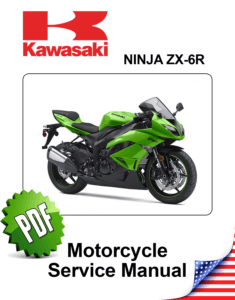
Kawasaki Ninja ZX6R 1995

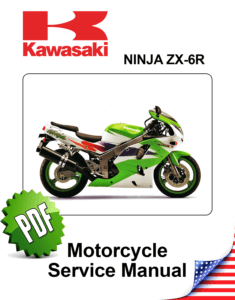
Kawasaki Ninja ZX6R F1-F3 Repair Manual (1995-97)

Complete PDF version of the Service Manual for the Kawasaki Ninja ZX6R F1-F3. A MUST for every ZX6R owner.

Download: Immediately after payment!

OEM Original factory workshop manual.

Models covered by this manual: 1995 to 1997

Number of pages: 310 pages

Table of contents:

Kawasaki Ninja ZX6R F1-F3

This PDF repair manual can be downloaded right after the payment process in complete, on the device of your choice.

We do not offer printed manuals, for the following reasons:

  1. it is more eco-friendly to use a digital version
  2. your manual never gets dirty or greasy
  3. you can always choose to print the specific page(s) you need to work on your bike
  4. you receive your manual immediately after payment
  5. it is searchable

Paypal Secure checkout


Kawasaki Ninja ZX6R

The Kawasaki Ninja ZX-6R is a 600cc class motorbike in Kawasaki‘s Ninja sport bike series. It was first presented in 1995 and has since been regularly upgraded in response to new models from Honda, Suzuki, and Yamaha. In the 1980s, the ZX series was known as the Ninja line of Kawasaki bikes, and it still bears that moniker today.

Kawasaki released the ZX-6R in 1995, with very similar appearance and characteristics to the ZX-9R introduced in 1994, including the ram-air intake that Kawasaki had developed since the 1990 ZX-11 (ZZ-R1100). The original ZX-6R weighed 401.2 lb (182.0 kg) dry, 454 lb (206 kg wet), and could accelerate from 0 to 60 mph (0 to 97 km/h) in 3.6 seconds. After four years of selling a 636 cc ZX-6R for street usage and a separate 599 cc ZX-6RR for displacement-restricted racing classes, Kawasaki only produced one ZX-6R in 2007. It displaced 599 cc.

The engines in previous years of the ZX-6R were all produced from the same basic design, but the all-new engine for 2007 was completely reworked from the crankcase up. Following in the footsteps of its competitors, Kawasaki’s new engine featured a stacked gear configuration with the crankshaft, primary drive, and countershaft arranged in a triangle structure for a shorter, more compact powertrain. It is now around 40 mm shorter in both length and breadth, and it is believed to provide more cornering space. Kawasaki states that by employing a former 125 cc Grand Prix racer as the ZX-6R’s head development rider, Tomomi Manako, an emphasis on track usage has been placed. The frame, swingarm, suspension, brakes, and body were all totally overhauled, and the bike has very few elements in common with the previous model. The color design of the ZX-6R was carried over to the 2008 model year.

Source: Wikipedia

Kawasaki Ninja ZX6R K9 Repair Manual (2009)

Complete PDF version of the Service Manual for the Kawasaki Ninja ZX6R K9. A MUST for every ZX6R owner.

Download: Immediately after payment!

OEM Original factory workshop manual.

Models covered by this manual: 2009

Number of pages: 675 pages

Table of contents:

Kawasaki Ninja ZX6R K9

This PDF repair manual can be downloaded right after the payment process in complete, on the device of your choice.

We do not offer printed manuals, for the following reasons:

  1. it is more eco-friendly to use a digital version
  2. your manual never gets dirty or greasy
  3. you can always choose to print the specific page(s) you need to work on your bike
  4. you receive your manual immediately after payment
  5. it is searchable
Paypal Secure checkout

Kawasaki Ninja ZX6R

The Kawasaki Ninja ZX-6R is a 600cc class motorbike in Kawasaki‘s Ninja sport bike series. It was first presented in 1995 and has since been regularly upgraded in response to new models from Honda, Suzuki, and Yamaha. In the 1980s, the ZX series was known as the Ninja line of Kawasaki bikes, and it still bears that moniker today.

Kawasaki released the ZX-6R in 1995, with very similar appearance and characteristics to the ZX-9R introduced in 1994, including the ram-air intake that Kawasaki had developed since the 1990 ZX-11 (ZZ-R1100). The original ZX-6R weighed 401.2 lb (182.0 kg) dry, 454 lb (206 kg wet), and could accelerate from 0 to 60 mph (0 to 97 km/h) in 3.6 seconds. After four years of selling a 636 cc ZX-6R for street usage and a separate 599 cc ZX-6RR for displacement-restricted racing classes, Kawasaki only produced one ZX-6R in 2007. It displaced 599 cc.

The engines in previous years of the ZX-6R were all produced from the same basic design, but the all-new engine for 2007 was completely reworked from the crankcase up. Following in the footsteps of its competitors, Kawasaki’s new engine featured a stacked gear configuration with the crankshaft, primary drive, and countershaft arranged in a triangle structure for a shorter, more compact powertrain. It is now around 40 mm shorter in both length and breadth, and it is believed to provide more cornering space. Kawasaki states that by employing a former 125 cc Grand Prix racer as the ZX-6R’s head development rider, Tomomi Manako, an emphasis on track usage has been placed. The frame, swingarm, suspension, brakes, and body were all totally overhauled, and the bike has very few elements in common with the previous model. The color design of the ZX-6R was carried over to the 2008 model year.

Kawasaki radically altered the design of the ZX-6R in 2009 to reflect the more angular appearance of the ZX-10R. According to Kawasaki, the new ZX-6R is 10 kilograms lighter than the previous model. The most significant improvements for 2009 were the reworking of the exhaust, which is now carried low and does not require the bulky under-seat structure of 2008, and the introduction of the Showa Big Piston Fork (BPF) suspension for a more progressive brake-dive. With an upgraded engine and slipper clutch, the 2010 ZX-6R is changing yet again. The exhaust pre-chamber has greater area and reduces exhaust noise, providing a smoother ride for the rider. The new twin bore intake funnels come in two different heights, providing performance gains at both high and low engine speeds. The front seat has been lowered.

Source: Wikipedia

Kawasaki KLX250 2nd gen

Kawasaki KLX250 D-TRACKER X 2nd generation Service Manual (2009-14)

Complete PDF version of the Service Manual for the Kawasaki KLX250 2nd generation. A MUST for every D-TRACKER X owner.

Download: Immediately after payment!

OEM Original factory workshop manual.

Models covered by this manual: 2009 to 2014

Number of pages: 558 pages

Table of contents:

Kawasaki KLX250

This PDF repair manual can be downloaded right after the payment process in complete, on the device of your choice.

We do not offer printed manuals, for the following reasons:

  1. it is more eco-friendly to use a digital version
  2. your manual never gets dirty or greasy
  3. you can always choose to print the specific page(s) you need to work on your bike
  4. you receive your manual immediately after payment
  5. it is searchable

Paypal Secure checkout


Kawasaki KLX250

The Kawasaki KLX250S is a two-wheeled motorbike. Kawasaki debuted the supermoto-inspired KLX 250SF to the market in 2009. It is a lightweight dual sport that may be used both on and off the road. Its 249 cc engine can reach speeds of up to 85 mph.

Generation 2 (2009-2014)

Differences from previous generation

  • Instrumentation is entirely digital.
  • Seat is now firmer.
  • New fender design and headlights
  • Broader spokes
  • Fuel capacity has been increased, and a new swing arm design has been introduced.
  • Front and rear suspension travel is reduced.
  • Ground clearance is somewhat reduced.
  • For the 2009 and 2010 model years, a supermoto-inspired KLX 250SF variant is offered.

Source: Wikipedia

Kawasaki KLR650 Supplementary 1987

Kawasaki KLR500/KLR650-A (1st generation) Supplementary Repair Manual (1987-2007)

Complete PDF version of the Supplementary Service Manual for the Kawasaki KLR500/650-A. A MUST for every KLR650-A owner.

Download: Immediately after payment!

Important: This Supplementary manual is to be used in conjunction with the standard Service Manual for the KLR600 that can also be found on this website.

OEM Original factory workshop manual.

Models covered by this manual: 1987 to 2007

Number of pages: 130 pages

Table of contents:

Kawasaki KLR650

This PDF repair manual can be downloaded right after the payment process in complete, on the device of your choice.

We do not offer printed manuals, for the following reasons:

  1. it is more eco-friendly to use a digital version
  2. your manual never gets dirty or greasy
  3. you can always choose to print the specific page(s) you need to work on your bike
  4. you receive your manual immediately after payment
  5. it is searchable

Paypal Secure checkout


Kawasaki KLR650

The Kawasaki KLR650 is a 651 cc (39.7 cu in) dual-sport motorbike designed for both on- and off-road use. It was a long-running model in Kawasaki‘s portfolio, having debuted in 1987 to replace the 564 cc (34.4 cu in) 1984–1986 Kawasaki KLR600 and lasting almost unaltered until the 2007 edition. The 2008 model was the KLR650’s first substantial change since its beginnings. The engine was a 651 cc four-stroke, DOHC, dual-counterbalanced, single-cylinder, water-cooled four-stroke. The KLR had a second big redesign in 2022, which included additional features like as fuel injection and ABS.

The KLR is popular as a low-cost adventure/tour bike. The inclusion of baggage and customized adaptations (GPS, heated handgrips, wider windscreens) make it more practical for extended journeys. Bikes have been used for long-distance and transcontinental journeys, as well as entire globe circumnavigation rides, such as those undertaken by Dr. Gregory Frazier in 2001 and 2002.

Generation 1 (1987-2007)

  • KLR650-A: Based on the KLR600, the “A” variant was released in 1987. (1984 to 1986). The “A” model stayed essentially unmodified until the 2008 model was introduced in the United States, Canada, Australia, and South Africa. Due to pollution rules, it is not available in Europe.
  • Tengai vs. KLR650-B: The Tengai has Adventure/Dakar style, a complete fairing that blends into the tank, different sidepanels, and an unsprung front mudguard. It was offered in the United States beginning in 1990 and in other countries for two years after that – this may be considered a different model in its own right because the others are more trail bike oriented. The name “Tengai” is a traditional Japanese phrase that signifies “The End of the Sky.”
  • KLR650-C: The “C” variant has a completely redesigned body and is a dirt-oriented motorbike with stronger 41 mm (1.6 in) front forks, upgraded brakes, a tubular engine guard, a smaller 14 l (3.1 imp gal; 3.7 US gal) petrol tank, and steel wheel rims. It lacks a temperature gauge but does include an over-heat bulb.
  • Hayes Diversified Technologies has adapted KLR650s for the US military to burn military-spec fuels such as diesel. (M1030M1) To replace the 4-stroke gasoline engines, all-new engines were developed. The original unit-construction main cases and transmission are used in the new engines, but new pistons, cylinders, and other components are used. The gasoline KLR650 engines’ balancing mechanism (used to decrease engine vibration) was removed from the military diesel KLR engines. Some components of the military diesel version, like as the nonspillable absorbed glass mat battery, can be used in “civilian” KLR650 variants, offering various advantages over standard unsealed KLR batteries.

Source: Wikipedia

Kawasaki KZ400 (1st generation) Models 1974 to 1975 Service Manual PDF download

Kawasaki KZ400 1st generation Service Manual (1974-75)

Complete PDF version of the Service Manual for the Kawasaki KZ400. A MUST for every KZ400 owner.

Download: Immediately after payment!

OEM Original factory workshop manual.

Models covered by this manual: 1974 and 1975

Number of pages: 189 pages

Table of contents:

Kawasaki KZ400Kawasaki KZ400

This PDF repair manual can be downloaded right after the payment process in complete, on the device of your choice.

We do not offer printed manuals, for the following reasons:

  1. it is more eco-friendly to use a digital version
  2. your manual never gets dirty or greasy
  3. you can always choose to print the specific page(s) you need to work on your bike
  4. you receive your manual immediately after payment
  5. it is searchable

Paypal Secure checkout


Kawasaki KZ400

The Kawasaki KZ400/Z400 is a street motorcycle manufactured by Kawasaki from 1974 to 1984. The dual cylinder engine’s displacement was raised to 443cc for the KZ440/Z440. A 399cc two-cylinder engine powered the subsequent KZ400-J.

From 1974 until 1984, the Kawasaki KZ400 was a 398 cc two engine motorbike. To decrease vibration, the engine included two balancer shafts, one in front of the crankshaft and one behind it, both moving in the opposite direction of the rotating crankshaft. An emission control system reused “by-product” gases. It was marketed as a “most practical all-around machine” by the producers.

Later variants displaced 443 cubic centimeters. The KZ400 was manufactured in Akashi, Japan, and Lincoln, Nebraska. With the construction of the Lincoln facility in 1974, Kawasaki became the first foreign motorcycle manufacturer to have a plant in the United States. Throughout the 1970s, the KZ400 outsold Honda in the 400 cc twins market. These bikes were touted as fuel-efficient vehicles; a 1975 magazine commercial for Kawasaki displayed the KZ400 next to a Volkswagen Beetle with the tag line “Think even smaller.”

Early versions had oil leaks and erratic idling. Beginning in 1977, both the carburetors and the architecture of the oil passageways were modified. Some variants were available as basic transportation, with no electric start and front drum brakes. Most, on the other hand, featured a single disc in front and a drum in the back, as well as electric and kick starters. A fairing and saddle bags were also included on the deluxe versions.

Source: Wikipedia

Kawasaki Vulcan VN900 Custom Repair Manual (2007-22)

Complete PDF version of the Service Manual for the Kawasaki Vulcan VN900 Custom. A MUST for every VN900 owner.

Download: Immediately after payment!

OEM Original factory workshop manual.

Models covered by this manual: 2007 to 2022

Number of pages: 617 pages

Table of contents:

Kawasaki Vulcan VN900 Custom service manual

This PDF repair manual can be downloaded right after the payment process in complete, on the device of your choice.

We do not offer printed manuals, for the following reasons:

  1. it is more eco-friendly to use a digital version
  2. your manual never gets dirty or greasy
  3. you can always choose to print the specific page(s) you need to work on your bike
  4. you receive your manual immediately after payment
  5. it is searchable

Paypal Secure checkout


Kawasaki Vulcan VN900

Since 1984, Kawasaki has used the Vulcan moniker for its custom or cruiser bikes, model code VN, with predominantly V-twin engines ranging from 125 to 2,053 cc (7.6 to 125.3 cu in).

2006-present: Vulcan 900 series

  • Vulcan 900 Classic
    • 903 cc (55.1 cu in) Liquid Cooled Fuel injected V-twin SOHC engine
    • 50 HP @ 5,700 RPM
    • 45.4 ft-lb TQ @ 3,500 RPM
    • Belt drive
    • Four-valve Cylinder Head
    • Tank-Mounted Speedometer with Turn Signal Indicators and Caution Lamps
  • Vulcan 900 Classic LT
    • Same as the Classic, with the addition of:
      • Passenger backrest, saddlebags, windshield, and studded accents standard
  • Vulcan 900 Custom
    • Same as the Classic, except for:
      • 180 mm rear tire, and a thin 21-inch cast front wheel
      • Smaller, lower-profile seat with smaller pillion
      • Drag-Style handlebars

Source: Wikipedia