Complete PDF version of the Service Manual for the Royal Enfield Himalayan EFI EURO V. A MUST for every Himalayan EFI owner.
Download: Immediately after payment!
OEM Original factory workshop manual.
Models covered by this manual: 2023 and later
Number of pages: 567 pages
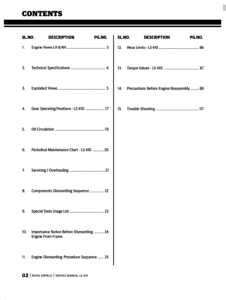
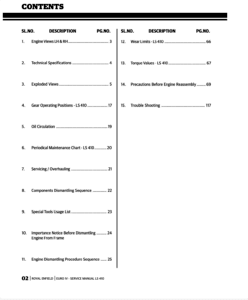
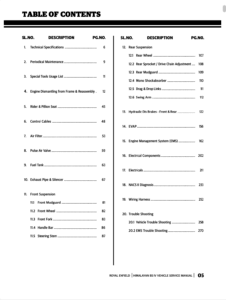
Table of contents:


This PDF repair manual can be downloaded right after the payment process in complete, on the device of your choice.
We do not offer printed manuals, for the following reasons:
- it is more eco-friendly to use a digital version
- your manual never gets dirty or greasy
- you can always choose to print the specific page(s) you need to work on your bike
- you receive your manual immediately after payment
- it is searchable

Royal Enfield Himalayan EFI Euro V
The Royal Enfield Himalayan was conceived as a fundamentally different motorcycle from the rest of the brand’s lineup. While Royal Enfield is best known for its classic, road-focused machines, the Himalayan was developed from the outset as a true adventure touring motorcycle, capable of handling long distances, poor road conditions, and off-road travel with equal confidence.
The project was led by Pierre Terblanche, formerly of Ducati and Moto Guzzi, under the direction of Royal Enfield CEO Siddhartha Lal. The goal was not to create a high-performance adventure bike, but a practical and durable machine designed for real-world travel, particularly in regions where road quality is unpredictable and simplicity matters more than outright speed.
Following its initial release in 2016, the Himalayan quickly gained a reputation for its comfortable suspension, stable handling, and ease of use. Riders praised its ability to absorb rough terrain and remain composed when loaded with luggage, even if early models were also criticized for inconsistent build quality. Over time, Royal Enfield responded with continuous improvements in manufacturing, components, and quality control, steadily refining the platform.
The Euro V Himalayan, produced from 2023 onward, represents the most mature version of the model to date. While retaining the same core character, it benefits from updated engine management, revised emissions systems, and improved overall refinement. These changes were implemented without altering the bike’s original philosophy, ensuring that the Himalayan remains approachable, mechanically simple, and well suited to long-distance adventure riding.
On the road, the Himalayan delivers a relaxed and confidence-inspiring riding experience. Power delivery is smooth and predictable, encouraging an unhurried riding style that suits touring and exploration. Off-road, the long-travel suspension, upright ergonomics, and large front wheel provide stability and control on gravel, dirt tracks, and uneven surfaces. The motorcycle’s balanced chassis and low center of gravity make it easy to manage at low speeds, particularly in technical terrain.
Ergonomics play a central role in the Himalayan’s appeal. The upright riding position reduces fatigue on long journeys, while the relatively low seat height and narrow midsection make the bike accessible to riders of varying experience levels. Practical details such as integrated luggage mounting points, a rear cargo rack, and optional jerrycan and pannier systems reinforce the Himalayan’s role as a travel-focused machine.
The instrument cluster blends traditional and modern elements, offering clear analog gauges alongside digital information and navigation support where equipped. Rather than overwhelming the rider with electronics, the Himalayan prioritizes essential information and usability, in keeping with its minimalist design ethos.
Over successive updates, the Himalayan has evolved into a dependable and versatile adventure motorcycle, valued for its durability, simplicity, and comfort rather than headline performance figures. The EFI Euro V generation stands as the most refined iteration of this concept, maintaining the Himalayan’s original purpose while meeting modern regulatory and usability expectations.
Technical Specifications
Engine
- Type: Single-cylinder, 4-stroke
- Displacement: 411 cc
- Valve train: SOHC, 2 valves
- Cooling: Air-oil cooled with external oil cooler
- Fuel system: Electronic Fuel Injection (EFI), Euro V
- Maximum power: approx. 24.5 hp @ 6,500 rpm
- Maximum torque: approx. 32 Nm @ 4,000–4,500 rpm
Transmission
- Gearbox: 5-speed constant mesh
- Clutch: Wet multi-plate
Chassis and Suspension
- Frame: Half-duplex split cradle steel frame
- Front suspension: 41 mm telescopic forks, approx. 200 mm travel
- Rear suspension: Monoshock, approx. 180 mm travel
- Ground clearance: approx. 220 mm
Brakes and Wheels
- Front brake: 300 mm disc, twin-piston caliper
- Rear brake: 240 mm disc, single-piston caliper
- ABS: Dual-channel ABS (rear switchable on some markets)
- Front wheel: 21-inch (90/90–21)
- Rear wheel: 17-inch (120/90–17)
Dimensions and Ergonomics
- Seat height: approx. 800 mm
- Riding position: Upright, touring-oriented
Production years
- 2023–present (EFI Euro V models)