
Kawasaki Ninja ZX-10R / ZX-10R ABS Racing Kit Manual (2011)
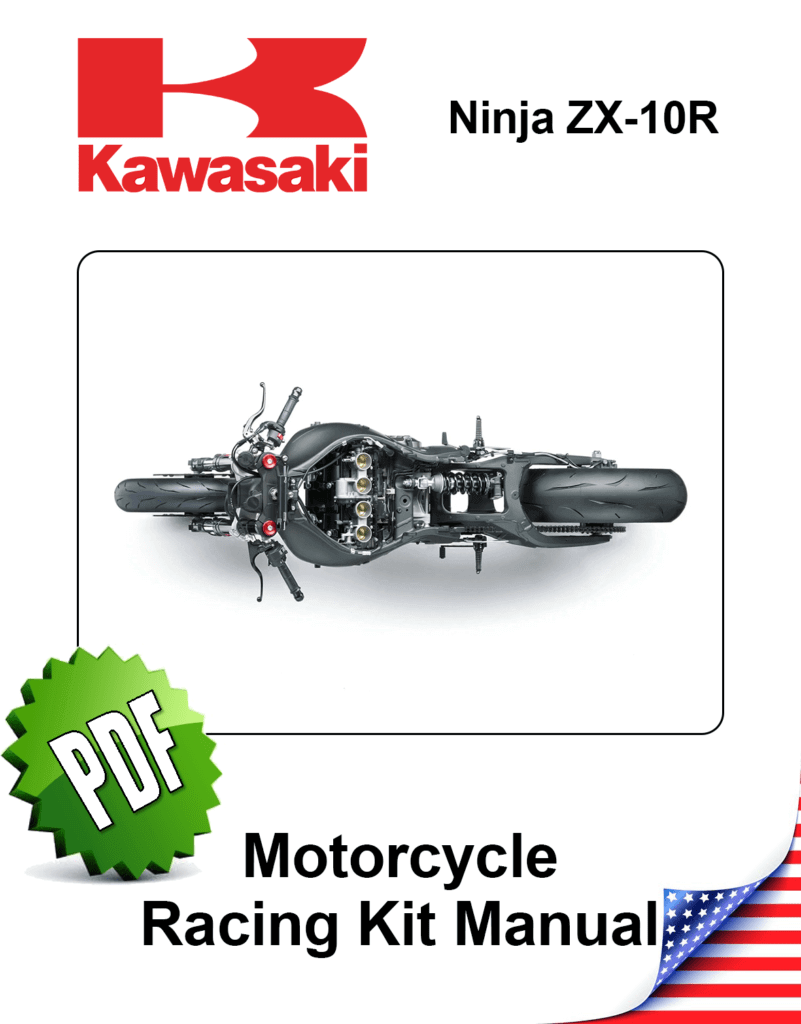

Kawasaki Ninja ZX-10R and ZX-10R ABS factory racing kit supplement for 2011 ZX1000J/K models. This 79-page searchable PDF contains racing-kit-specific specifications and setup information including optional transmission ratios, racing service data, competition maintenance intervals, engine preparation, camshafts and valve timing, cylinder-head and compression setup, crankshaft and connecting-rod clearances, back-torque limiter clutch adjustment, racing transmission parts, kit ECU functions, throttle and chain components, brake pads, steering damper, ride-height and fork-spring options, racing harness installation, wheel-speed sensors, wiring diagram and racing kit parts lists. It is not a replacement for the base service manual; Kawasaki directs the reader to Service Manual 99924-1443-01 for standard motorcycle service procedures.
About the Manual
- Manual type
- Racing Kit Manual
- Years covered*
- 2011
- Pages
- 79
- Language
- English
- Format
- Main sections
- 9
- Searchable PDF
- Yes
- Printable PDF
- Yes
- File size
- 951.3 KB
- Delivery
- Digital download
* Indicative only. Please do your own research and confirm compatibility with your exact motorcycle and model year before purchasing.
Kawasaki Ninja ZX10R 4th Generation (ZX1000J/K) Motorcycle Details
What’s Included in the Kawasaki Ninja ZX10R 4th Generation (ZX1000J/K) Service Manual?
- General Specifications
- Racing Kit Service Data
- Periodic Maintenance Chart
- Preparation
- Engine Parts Installation
- Frame Parts Installation
- Electric Parts Installation
- Wiring Diagram
- Racing Kit Parts List
Preview Inside the Manual
See a selection of pages from this service manual before purchasing.
Click a sample page to enlarge it. Preview images are excerpts only; the complete manual is supplied after purchase.
Get the Complete Kawasaki Ninja ZX10R 4th Generation (ZX1000J/K) Service Manual
79 pages • PDF • Instant download
About the Kawasaki ZX10R
Kawasaki introduced the Ninja ZX-10R in 2004 as the top model in its supersport range, building the litre-class Ninja around circuit performance from the outset. Kawasaki's 2004 annual report described the new ZX-10R as its top-of-the-line Super Sports model and highlighted its class-leading power-to-weight focus. That race-oriented identity became central to the ZX10R family, with successive redesigns aimed less at broad touring versatility than at extracting faster, more controllable performance from a production-based superbike platform.
The 2011 model was an especially important reset. At INTERMOT 2010, Kawasaki announced an all-new Ninja ZX-10R with a newly designed engine, frame and suspension system, more than 10 kg less mass than the previous model, and electronics developed specifically around circuit riding. The new S-KTRC traction-control system estimated multiple parameters to maximize acceleration, while optional KIBS brought a supersport-specific anti-lock braking strategy. The same redesign introduced a new aluminum twin-tube frame, Big Piston Fork front suspension and horizontal back-link rear suspension, making the 2011 motorcycle a major break from the previous generation rather than a minor annual revision.
In standard road specification, the 2011 bike is a 998 cc litre-class superbike powered by a liquid-cooled DOHC 16-valve inline four. Kawasaki's archived 2011 model specifications list a 76.0 × 55.0 mm bore and stroke, 13.0:1 compression, four 47 mm Keihin fuel-injection throttle bodies, a wet multi-disc clutch, six-speed cassette transmission and chain final drive. The platform's electronics and cassette gearbox also made it unusually well suited to track conversion because gearing, engine-braking behavior, traction-control strategy and chassis setup could all be adapted without changing the motorcycle's core architecture.
The model remained the basis of Kawasaki's flagship production-racing effort through the middle of the decade. For 2016, Kawasaki described the next ZX-10R as an evolution of the high-performance supersport model first introduced five years earlier, with extensive World Superbike feedback applied to the engine, chassis and electronic controls. That 2016 update marks the next major platform break and helps define the 2011–2015 J/K-series motorcycles as a distinct technical generation whose electronics and racing hardware were developed together from the start.
This download is the factory racing-kit supplement for the **2011** J/K platform, not the ordinary workshop manual. It covers competition-only setup such as alternate gearbox ratios, race camshafts and valve timing, compression and bearing-clearance targets, back-torque limiter settings, kit ECU functions including launch control and S-KTRC configuration, racing suspension parts and the kit wiring harness. Kawasaki explicitly tells the reader to use base Service Manual 99924-1443-01 for standard servicing. Related workshop publications can be browsed in the Kawasaki Ninja ZX-10R manual category.
Why Choose a Digital PDF Service Manual?
We supply service manuals as digital PDF downloads rather than printed books.
We do not offer printed manuals. Digital delivery has several practical advantages:
- Digital delivery avoids producing and shipping an additional printed copy.
- Keep your master copy clean and grease-free while you work on your motorcycle.
- Print only the specific page or pages you need for the job.
- Access the manual immediately after successful payment.
- Search the PDF to find terms, procedures and components quickly.
Related Kawasaki Service Manuals
Kawasaki Ninja ZX-10R / ZX-10R ABS / ZX-10RR Mk5 Service Manual (2016–2019)
804-page Kawasaki Ninja ZX-10R, ZX-10R ABS and ZX-10RR factory service manual PDF covering applicable 2016-2019 ZX1000R, ZX1000S and ZX1000Z models.
Kawasaki Ninja ZX-10R / ZX-10R ABS / ZX-10RR Mk6 Service Manual (2021-2023)
Factory Kawasaki Ninja ZX-10R, ZX-10R ABS and ZX-10RR service manual for 2021-2023 ZX1002L, ZX1002M and ZX1002N models. This 862-page searchable PDF covers the 998 cc DOHC inline-four engine, scheduled maintenance, valve-clearance adjustment, DFI fuel injection, cooling and lubrication systems, clutch and six-speed transmission, chain final drive, brakes, suspension, steering, electrical troubleshooting, self-diagnosis and factory wiring diagrams. Covers the ZX1002L, ZX1002M and ZX1002N model families. Instant PDF download. Searchable and printable.
Kawasaki Ninja ZX-10R / ZX-10R ABS Mk4 Service Manual (2011-2013)
Factory Kawasaki Ninja ZX-10R and ZX-10R ABS service manual covering 2011-2013 models. This 768-page searchable PDF covers the 998 cc DOHC inline-four engine, scheduled maintenance, valve adjustment, fuel injection, S-KTRC traction control, Power Modes, KIBS ABS diagnostics, clutch and six-speed transmission, cooling system, suspension, brakes, self-diagnosis and factory wiring diagrams.
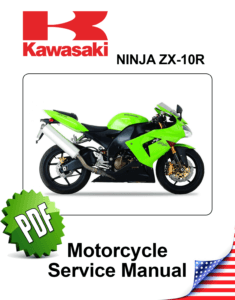
Kawasaki Ninja ZX-10R Mk1 Repair Manual (2004-2005)
Factory Kawasaki Ninja ZX-10R service manual for the 2004-2005 ZX1000-C1/C2 first-generation model. This 599-page PDF covers the 998 cc DOHC inline-four engine, scheduled maintenance, valve adjustment, DFI fuel injection, cooling and lubrication systems, clutch and six-speed transmission, chain final drive, brakes, suspension, electrical troubleshooting, immobilizer systems and factory wiring diagrams.
Get the Kawasaki Ninja ZX10R 4th Generation (ZX1000J/K) Service Manual
Click the Buy Now button below to get the complete PDF manual.